Visible Veins Explained: A Detailed Guide
Seeing veins through the skin can be alarming, but visible veins are often a normal feature of the body’s circulation. Whether they are harmless or need medical attention depends on their location, appearance, how suddenly they appeared, and whether you have other symptoms.
1. Why do veins become visible?
Veins carry blood back toward the heart. Many veins, particularly superficial veins, run relatively close to the surface of the skin. They can therefore become visible when the tissues surrounding them change.
Several factors can make this happen:
Exercise
After exercise—especially weightlifting, resistance training, running, or other intense activity—muscles need more blood.
Blood vessels supplying the muscles widen, blood flow increases, and superficial veins can become more prominent. This is sometimes called vascularity.
It’s usually temporary and becomes less noticeable after you cool down and your circulation returns to its resting state.
Low body fat
People with a lower percentage of body fat often have more visible veins because there is less fatty tissue between the veins and the skin.
This is particularly noticeable in:
- Forearms
- Hands
- Biceps
- Shoulders
- Legs
- Abdomen
In an otherwise healthy person, this is generally normal.
Thin skin
The skin becomes thinner with age, and some people naturally have relatively thin or translucent skin. As a result, underlying blood vessels become easier to see.
This is particularly common on the backs of the hands and forearms.
Heat
Hot weather, hot showers, saunas, and strenuous activity can cause blood vessels near the skin to dilate.
As the superficial veins become fuller, they may temporarily look larger or darker.
Genetics
Some people naturally have prominent veins. If your parents or other family members have visible veins, you may be more likely to have them too.
Dehydration
Significant dehydration can alter blood volume and make veins appear more pronounced, particularly during exercise.
However, prominent veins are not a reliable way to diagnose dehydration. Thirst, dark urine, reduced urination, dizziness, and dry mouth are more useful clues.
2. Visible veins in different parts of the body
The location makes a difference.
Hands
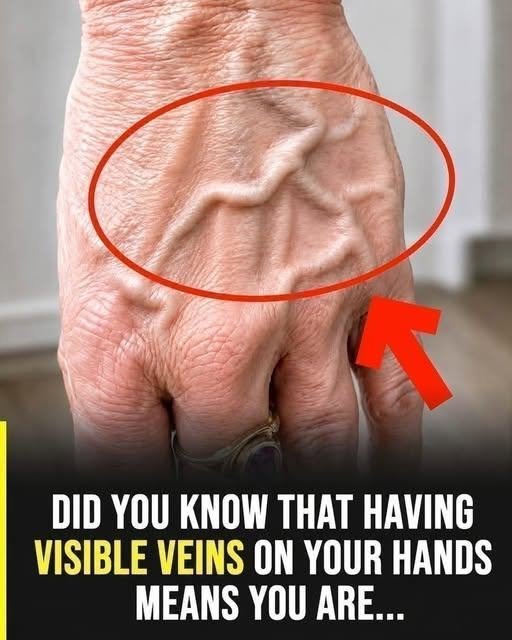
Prominent veins on the hands are extremely common.
They become more noticeable with:
- Aging
- Exercise
- Heat
- Low body fat
- Naturally thin skin
If the veins are symmetrical and there is no pain, swelling, redness, or other unusual change, they are usually not concerning.
Arms
Visible forearm or biceps veins are particularly common in people who exercise regularly or have relatively low body fat.
Weight training can make them especially prominent temporarily.
A vein that has gradually become more visible without other symptoms is generally less concerning than a vein that suddenly becomespainful, hard, red, or swollen.
Legs
Visible veins in the legs deserve somewhat more attention.
Small superficial veins or spider veins can be harmless. Larger, twisted, rope-like veins may be varicose veins.
Varicose veins can cause:
- Aching
- Heaviness
- Throbbing
- Itching
- Swelling around the ankles
- Symptoms that worsen after prolonged standing
They occur when valves inside veins don’t work efficiently, allowing blood to pool in the veins.
Feet and ankles
Veins can become prominent around the feet and ankles after standing for long periods, during hot weather, or after exercise.
However, persistent swelling of one foot or ankle, especially when accompanied by pain or warmth, warrants medical assessment.
Chest
Visible chest veins can occur naturally, particularly in people with low body fat or increased muscle definition.
They can also become more visible during exercise or heat.
A sudden change accompanied by breast/chest swelling, a new lump, skin changes, or unexplained pain should be evaluated by a healthcare professional.
3. Varicose veins vs. normal visible veins
This distinction is important.
Normal superficial veins
They are generally:
- Relatively straight
- Soft
- Not painful
- Similar on both sides
- More visible in certain situations
- Not associated with significant swelling or skin changes
Varicose veins
They tend to be:
- Enlarged
- Twisted or rope-like
- More prominent when standing
- Usually found in the legs
- Sometimes associated with aching or heaviness
Varicose veins aren’t necessarily dangerous, but severe or symptomatic cases can lead to complications such as skin changes, ulcers, bleeding, or inflammation.
4. When could a visible vein indicate a blood clot?
A deep-vein thrombosis (DVT) is a blood clot in a deep vein, usually in the leg.
Importantly, simply seeing a vein does not mean you have a DVT.
More concerning symptoms include:
- Swelling, particularly inone leg
- New leg pain or tenderness
- Warmth
- Redness or discoloration
- A feeling of heaviness or tightness
- Symptoms that appear relatively suddenly
A DVT requires medical evaluation because a clot can potentially travel to the lungs.
Emergency warning signs
If you have possible DVT symptoms and suddenly develop:
- Difficulty breathing
- Chest pain, particularly with breathing
- Coughing up blood
- Rapid heartbeat
- Fainting or severe dizziness
seek emergency medical care immediately.
These symptoms can occur with a pulmonary embolism, which can be life-threatening.
5. What about a painful, hard vein?
A vein that suddenly becomes tender, hard, red, or warm may have inflammation and/or a clot in a superficial vein, a condition called superficial thrombophlebitis.
It is different from a DVT, but it still deserves medical assessment—particularly if:
- The affected area is extensive
- Symptoms are worsening
- The leg is swollen
- You have risk factors for blood clots
- The symptoms are close to the groin or behind the knee
Don’t massage a suspicious painful/swollen area aggressively.
6. Risk factors that make clot symptoms more important
The likelihood of a blood clot is higher in certain circumstances, including:
- Recent major surgery
- Prolonged bed rest or immobility
- Long-distance travel with prolonged sitting
- Previous DVT or pulmonary embolism
- Certain cancers
- Pregnancy or the postpartum period
- Some hormone-containing medications
- Certain inherited clotting disorders
- Significant injury or trauma
Having a risk factor doesn’t mean you have a clot, but new compatible symptoms should be taken more seriously.
7. When should you see a doctor about visible veins?
Make a routine medical appointment if visible veins are accompanied by:
- Persistent leg swelling
- Recurrent aching or heaviness
- Skin discoloration
- Itching around varicose veins
- Skin becoming unusually hard or thin
- Sores or ulcers near the ankle
- Recurrent bleeding from a vein
- A noticeable change that doesn’t have an obvious explanation
You should seek prompt medical assessment for sudden one-sided swelling, pain, warmth, or redness.
And seek emergency care for symptoms suggestive of a pulmonary embolism, particularly sudden shortness of breath or chest pain.
8. Can visible veins be reduced?
If they’re normal and simply cosmetic, there isn’t necessarily anything that needs to be treated.
For prominent leg veins, measures that can sometimes improve symptoms include:
- Regular walking and physical activity
- Avoiding prolonged periods of standing or sitting
- Elevating the legs when appropriate
- Maintaining a healthy body weight
- Discussing compression stockings with a healthcare professional if appropriate
For troublesome varicose veins, clinicians can consider treatments such as sclerotherapy, thermal ablation, or other vein procedures, depending on the individual situation.
9. A useful way to judge whether a vein is concerning
Think about four things:
Appearance: Is it simply visible, or is it twisted, swollen, red, or hard?
Timing: Has it always been visible, or did it appear suddenly?
Symptoms: Is there pain, warmth, swelling, itching, or tenderness?
Location: Is it on both sides in a typical superficial location, or is there a sudden change affecting one limb?
Usually reassuring “My forearm veins have become more visible since I started exercising, but there is no pain, swelling, redness, or other symptom.”
This is generally much less concerning.
More concerning “A vein in one leg suddenly became prominent, painful, hard, and the leg is swollen.”
That should be medically evaluated.
Emergency “My leg is swollen and painful, and now I suddenly have chest pain or difficulty breathing.”
That requiresemergency medical attention.
Bottom line
Visible veins are not, by themselves, usually a sign of disease. Exercise, genetics, low body fat, heat, aging, and naturally thin skin can all make normal veins much easier to see.
What matters most is a new or rapidly changing appearance, especially when accompanied by pain, swelling, warmth, redness, hardness, or one-sided symptoms. Sudden breathing difficulty or chest pain in the setting of possible clot symptoms is an emergency.