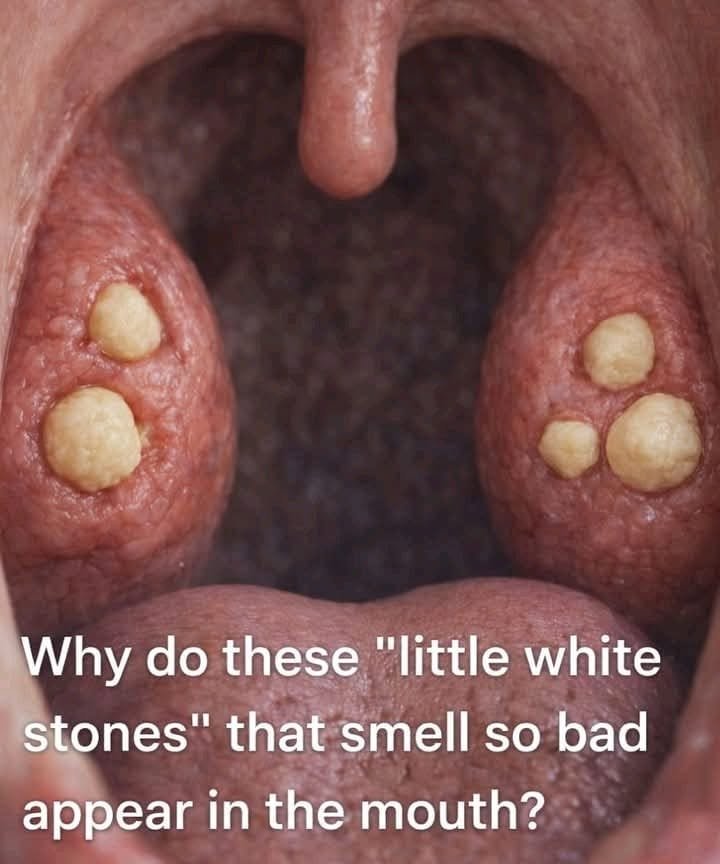
That headline hits on one of the body’s most bizarre and startling little mysteries. When you suddenly discover a tiny, foul-smelling white or yellowish lump popping out of the back of your throat, it feels alarming—like something is seriously wrong.
In clinical reality, while they are undeniably gross, these little stones are entirely benign and very common.
Here is the straightforward, un-sensationalized medical reality behind what they are and why they happen:
1. What Are They? (Tonsil Stones / Tonsilloliths)
Those small, stinky white stones are called tonsilloliths, or more commonly, tonsil stones.
-
Your tonsils are not smooth surfaces; they are full of tiny crevices, crypts, and folds designed to trap bacteria and debris as part of your immune system.
-
Over time, a mix of dead cells, mucus, food particles, and bacteria gets trapped inside these deep tonsil crypts. If that trapped debris calcifies or hardens over time, it forms a small, crumbly white stone.
2. Why Do They Smell So Bad?
If you’ve ever accidentally crushed one, you know the odor is intensely foul—often described as sulfurous or smelling like rotten eggs.
-
The culprits are anaerobic bacteria living deep inside the tonsil crypts. Because these bacteria thrive in oxygen-free environments, they break down proteins and release volatile sulfur compounds, which creates that notoriously potent, bad-breath smell.
3. How to Manage and Prevent Them Safely
While tonsil stones can be annoying and cause chronic bad breath (halitosis) or a feeling that something is stuck in your throat, they rarely require surgery unless they are chronically infected or massive.
-
Gentle Removal: If you feel them, many people gently dislodge them at home using a cotton swab or by gargling vigorously with warm saltwater. Never use sharp metal tools or fingernails, as tonsil tissue is extremely delicate and prone to bleeding and infection.
-
Prevention: Good oral hygiene goes a long way. Brushing your tongue, flossing daily, and using an alcohol-free mouthwash helps reduce the overall bacterial load in your mouth that feeds the stones. Hydration also keeps your saliva flowing, which naturally flushes out debris.
The Takeaway: Those smelly little white stones aren’t a sign of a mysterious disease—they are just calcified clusters of trapped bacteria and debris hiding in the folds of your tonsils.
Did one of these strange little stones make a surprise appearance for you, or were you just diving down a weird-body-quirk rabbit hole online?
