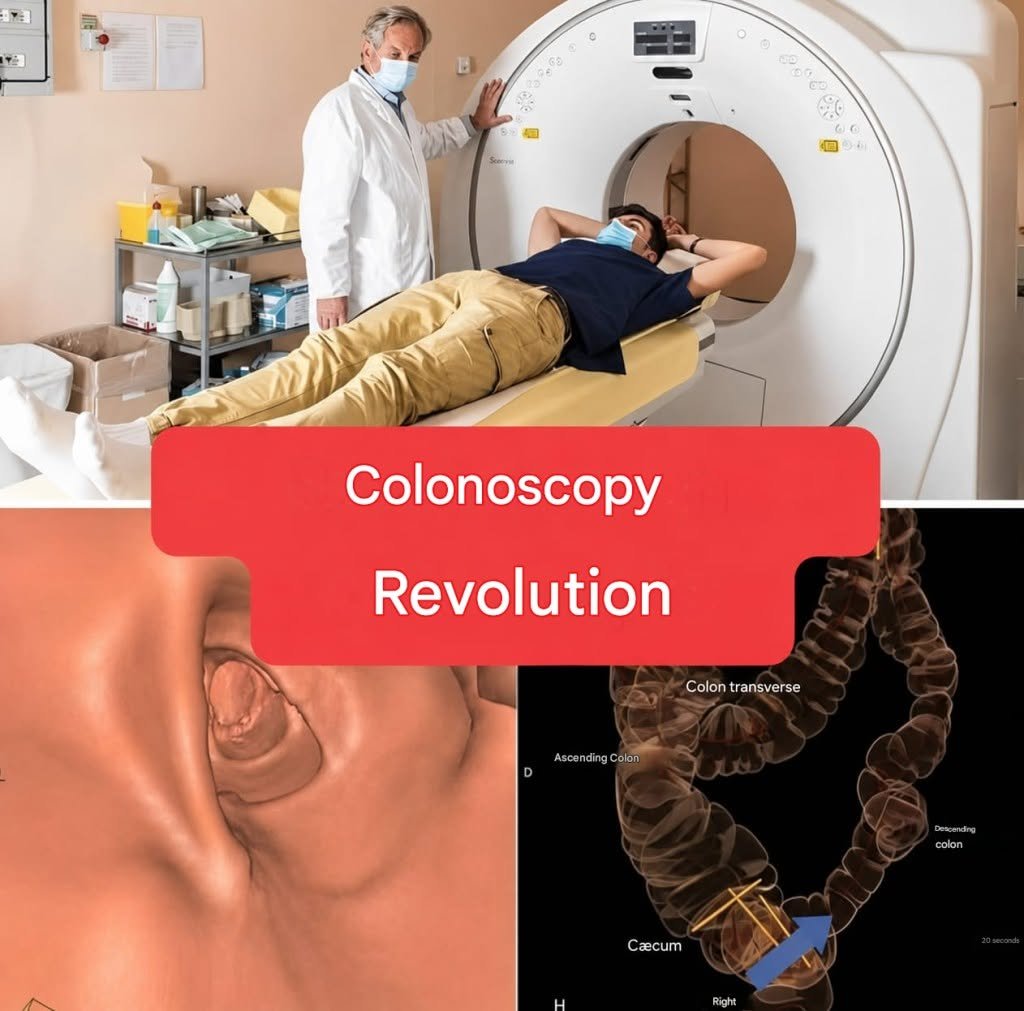
Is Colonoscopy About to Become Non-Invasive?
Partly—but the headline “colonoscopy will no longer be invasive” is misleading. There are several newer ways to examine or screen the colon without inserting a conventional colonoscope, but traditional colonoscopy has not been replaced as of 2026. Mayo Clinic+1
1. The “camera pill” approach
One of the most interesting alternatives is colon capsule endoscopy.
Instead of inserting a flexible camera through the rectum, the patient swallows a capsule containing cameras. As it travels through the digestive tract, it takes images that can be analyzed afterward.
Recent research describes colon capsule endoscopy as a genuinely non-invasive alternative and shows that it is increasingly being studied for colorectal screening. PubMed+1
The major advantage is obvious:
No colonoscope is physically inserted into the colon.
However, there’s an important limitation: the capsule can’t remove a polyp or take a biopsy. If it finds something suspicious, conventional colonoscopy may still be necessary. MDPI
And you generally still need substantial bowel preparation so that the camera can see the intestinal lining clearly.
2. “Virtual colonoscopy” already exists
Another established alternative is CT colonography, commonly called a virtual colonoscopy.
Instead of a long camera being advanced through the colon, CT imaging creates detailed images of the colon from outside the body. It is considered less invasive than conventional colonoscopy and doesn’t require sedation. Mayo Clinic+1
But it isn’t completely effortless: bowel preparation is still required, and if the scan detects a suspicious polyp, a conventional colonoscopy may be needed to remove it or obtain tissue. Mayo Clinic
3. Stool tests are becoming more sophisticated
There are also increasingly advanced non-invasive stool tests that look for blood, DNA, or RNA signals associated with colorectal cancer and precancerous lesions.
The American Cancer Society’s 2026 update includes high-sensitivity stool tests among the preferred colorectal-cancer screening options for appropriate average-risk adults. Guideline Central+1
A newer approach called multitarget stool RNA testing is now part of the evolving screening landscape.
But there’s an important catch: A positive non-colonoscopy screening test generally still requires follow-up colonoscopy. PubMed+1
4. Blood tests are another emerging possibility
Researchers are also developing blood tests capable of detecting signals associated with colorectal cancer and even precancerous advanced adenomas.
For example, an experimental blood test reported in August 2026 detected 92% of stage I–III colorectal cancers and 81% of advanced adenomas in a study of more than 1,500 people. However, this was still an experimental test, and larger studies are needed before it can replace colonoscopy. Reuters
5. AI is changing colonoscopy—but not eliminating it
There’s another important development: AI-assisted colonoscopy.
Here, the procedure remains invasive, but artificial intelligence analyzes the live camera images and helps the clinician identify polyps and suspicious lesions. Research suggests AI can improve adenoma detection. PubMed Central (PMC)+1
So AI isn’t currently making colonoscopy non-invasive; it’s making the existing procedure more accurate and potentially safer.
Why hasn’t traditional colonoscopy disappeared?
The biggest advantage of conventional colonoscopy is that it can do three things in one procedure:
- See the colon directly.
- Take a biopsy.
- Remove potentially precancerous polyps immediately.
Most non-invasive tests can do the first—or detect signs suggesting a problem—but they can’t simultaneously remove the abnormal tissue.
That’s why current guidelines still retain colonoscopy as an important test. The American Cancer Society continues to list colonoscopy every 10 years as one of the preferred structural screening options for average-risk adults, alongside other screening methods. Cancer.org+1
So, is the claim true?
“Colonoscopy will no longer be invasive” — Not yet.
A more accurate statement would be: “New non-invasive technologies—including capsule cameras, CT colonography, advanced stool tests, and emerging blood tests—are making it increasingly possible to screen for colorectal cancer without initially undergoing a conventional colonoscopy.”
That’s a significant development, but colonoscopy remains necessary for many people, particularly when a non-invasive test is positive or when a doctor needs to biopsy or remove a lesion.
If you’d like, I can also explain the new 2026 colon-cancer screening options (stool test vs blood test vs capsule vs virtual colonoscopy vs traditional colonoscopy) and which is best for different ages.