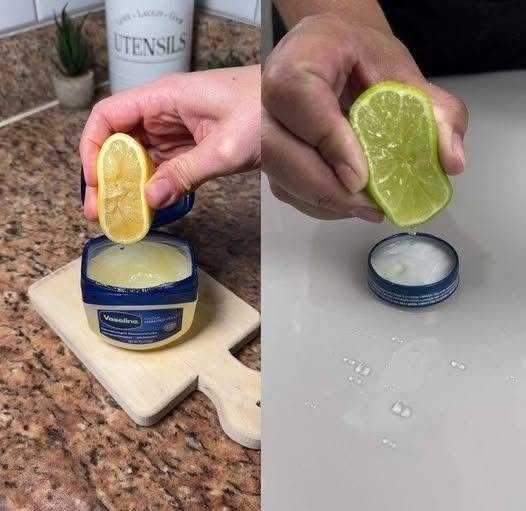
Mixing Vaseline and Lemon? of those homemade beauty remedies that sounds almost too simple to resist. You may have seen claims that mixing the two can brighten dark spots, soften If Only I Had Known That Sooner!
The combination of Vaseline and lemon is one of those homemade beauty remedies that sounds almost too simple to resist. You may have seen claims that mixing the two can brighten dark spots, soften wrinkles, remove dry skin, lighten elbows and knees, or give the face a smoother appearance.
There is one important problem: lemon juice isn’t a particularly skin-friendly ingredient, especially when applied directly to the face.
Vaseline, on the other hand, is a well-established occlusive moisturizer. It can help reduce water loss from the skin and protect dry, irritated areas. But mixing it with lemon doesn’t turn it into a miracle anti-aging or whitening treatment.
In fact, for facial skin, you are generally better off using Vaseline by itself and leaving lemon out.
What Vaseline Actually Does
Vaseline is a brand of petrolatum, an occlusive substance that forms a protective layer over the skin.
Rather than adding a large amount of water to your skin, petrolatum primarily helps reduce water loss from the outer layer of the skin.
That makes it useful for:
- Very dry skin
- Chapped areas
- Rough elbows and knees
- Dry lips
- Protecting irritated skin
- Supporting the skin barrier
If your skin feels tight and flaky, a thin layer of petrolatum over moisturizer can help keep moisture in.
That’s a legitimate skincare benefit—not a myth.
What Does Lemon Do to the Skin?
Lemon juice is acidic and contains various compounds, including vitamin C.
That may sound beneficial, but fresh lemon juice is not the same thing as a properly formulated vitamin C skincare product.
Applying lemon juice directly to your skin can cause:
- Burning
- Stinging
- Redness
- Dryness
- Irritation
- Increased sensitivity
There’s another important concern: citrus compounds on the skin can interact with sunlight and cause a reaction known as phytophotodermatitis.
This can result in redness, blistering, and later dark pigmentation.
So the idea that lemon is a harmless natural skin brightener is misleading.
Does Vaseline and Lemon Remove Dark Spots?
There is no good evidence that mixing Vaseline with lemon juice safely removes facial dark spots.
Dark spots are usually caused by increased pigmentation resulting from things such as:
- Sun exposure
- Acne or skin inflammation
- Hormonal changes
- Skin injuries
- Certain medications
- Normal aging
Irritating the skin with lemon juice can actually make pigmentation more noticeable, especially in people prone to post-inflammatory hyperpigmentation.
If your goal is to fade dark spots, daily sunscreen and appropriately formulated ingredients are much more sensible choices.
What About Wrinkles?
Neither lemon juice nor a Vaseline-lemon mixture can erase wrinkles.
Vaseline can make dry skin look temporarily smoother because better-hydrated skin often appears softer and less flaky.
But that’s different from rebuilding collagen or reversing skin aging.
For long-term improvement in fine lines, the evidence is much stronger for:
- Consistent sun protection
- Moisturization
- Retinoids when appropriate
- Avoiding smoking
- A generally healthy lifestyle
No homemade mixture can permanently tighten or rejuvenate facial skin overnight.
Can It Lighten the Face?
Be very cautious with claims that lemon can “bleach” or permanently lighten your complexion.
Healthy skin shouldn’t need to be bleached.
If you have uneven pigmentation, the goal should generally be treating excess pigmentation while protecting your natural skin barrier, not trying to dramatically alter your overall skin color.
Harsh DIY treatments can cause irritation, which may lead to darker marks afterward.
Why the Combination Seems to Work for Some People
You might wonder why people report that their skin looks better after using Vaseline and lemon.
There are several possible explanations.
Vaseline can reduce water loss and make dry skin look smoother. If the skin was very dry, that alone can create a noticeable temporary improvement.
Exfoliation or irritation can also make the surface appear temporarily different.
But a temporary cosmetic effect doesn’t prove that the mixture is safely treating pigmentation, wrinkles, or aging.
Anecdotal results shouldn’t be confused with evidence that a treatment is safe or effective.
A Safer Alternative: Use Vaseline Alone
If what you want is softer, smoother-looking skin, you don’t need lemon.
At night, apply your normal moisturizer first. Once it has absorbed, you can apply a very thin layer of Vaseline over particularly dry areas.
This helps reduce moisture loss while you sleep.
You don’t need a thick coating.
And because petrolatum can feel heavy or greasy, you may prefer to use it only on dry patches rather than across your entire face.
What About Acne-Prone Skin?
Vaseline itself isn’t inherently harmful for acne-prone skin, but applying a heavy layer over products that are irritating or pore-clogging for you may not feel comfortable.
If you’re prone to acne, start with a small area and use a thin amount.
Most importantly, don’t mix Vaseline with lemon juice simply because you believe the combination will prevent breakouts or fade acne scars.
Acne and post-acne pigmentation require different approaches.
If You Want to Treat Dark Spots, Try This Instead
A much safer routine is:
Morning
Use a gentle cleanser if necessary, followed by moisturizer and broad-spectrum sunscreen.
Sunscreen is particularly important because ultraviolet exposure can worsen pigmentation and make dark spots persist.
Evening
Cleanse gently and moisturize.
Depending on the type of pigmentation and your skin’s sensitivity, evidence-based ingredients such as azelaic acid, retinoids, or properly formulated vitamin C products may be appropriate.
Introduce active ingredients gradually.
Using several strong products simultaneously can irritate the skin and potentially make pigmentation worse.
If Your Skin Is Extremely Dry
Here’s where Vaseline can genuinely be useful.
After washing your face with a gentle cleanser, don’t completely dry the skin until it becomes tight and uncomfortable.
Apply a moisturizer, then use a very thin layer of petrolatum over the driest areas.
This approach is sometimes called occlusive skincare.
The purpose isn’t to “bleach” or “lift” the skin.
It’s simply to help the skin retain moisture and support the barrier.
Never Put Lemon Near Your Eyes
This deserves special emphasis.
The skin around your eyes is thin and sensitive.
Lemon juice can cause significant irritation if it gets into the eyes, and applying it close to the eye area for the purpose of removing dark circles isn’t worth the risk.
Dark circles also have many causes, including genetics, pigmentation, visible blood vessels, allergies, lack of sleep, and facial anatomy.
Lemon isn’t a universal solution.
What If You’ve Already Applied Lemon and Vaseline?
Don’t panic.
If your skin feels normal, gently wash the mixture off and avoid further use.
If your skin is burning or irritated, rinse thoroughly with water and avoid additional irritating products.
Because citrus exposure can increase sensitivity to sunlight, protect the affected skin from sunlight.
If you develop significant blistering, swelling, severe pain, or a pronounced skin reaction, seek medical advice.
The Biggest Mistake With DIY Skincare
Natural doesn’t automatically mean gentle.
Lemon is natural.
So are many other substances that can irritate or damage skin.
The skin has a carefully maintained barrier. A product that is acidic, abrasive, or irritating can disrupt that barrier even if it comes directly from the kitchen.
That’s why dermatology generally favors formulated skincare products with known concentrations, appropriate pH, and safety testing over improvised mixtures.
The Bottom Line
The idea of mixing Vaseline and lemon sounds appealing because both ingredients are inexpensive and easy to find.
But there’s an important distinction:
Vaseline can be useful skincare. Lemon juice is not a recommended DIY facial treatment.
Vaseline can help protect dry skin and reduce moisture loss. Lemon juice, however, can irritate the skin and may cause a sunlight-related reaction that can leave pigmentation behind.
So if you want the benefits of Vaseline, use it without the lemon.
For dark spots, prioritize sunscreen and evidence-based pigmentation treatments. For wrinkles, focus on sun protection, moisturization, and proven anti-aging ingredients. And for very sensitive areas such as the skin around your eyes, skip homemade acidic remedies altogether.
Sometimes the best beauty “secret” isn’t a complicated mixture.
It’s knowing which ingredient to leave out.