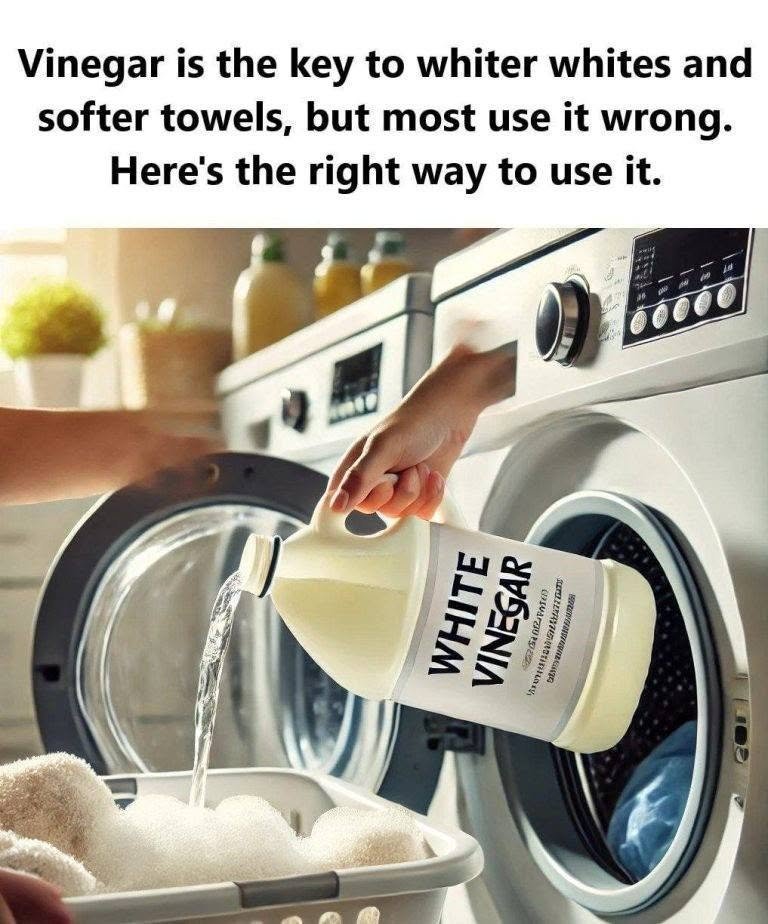
Vinegar: The Key to Whiter Whites and Softer Towels (But Most People Use It Wrong). Here’s the Right Way
If your white clothes have started looking dull, your towels feel stiff, or your laundry comes out of the washing machine smelling less than fresh, you may have heard an old-fashioned solution: white vinegar.
Vinegar is inexpensive, widely available, and useful for certain laundry tasks. But it’s also surrounded by exaggerated claims. It isn’t a miracle whitening agent, and using it incorrectly can damage some fabrics or create dangerous chemical reactions.
Used appropriately, however, vinegar can be a useful addition to your laundry routine—particularly for reducing detergent residue and helping towels feel less stiff.
1. What Makes Vinegar Useful in Laundry?
Distilled white vinegar contains acetic acid, which gives it its characteristic sour smell and acidic properties.
That acidity can help dissolve certain mineral deposits and residues left behind by detergents and hard water.
This is particularly relevant when towels feel stiff or rough after repeated washing.
The key is understanding what vinegar can do and what it can’t.
It can help with residue and odors.
It should not be treated as a magical replacement for laundry detergent or a guaranteed whitening treatment.
2. Vinegar Can Help Towels Feel Less Stiff
If your towels feel rough and crunchy rather than soft and absorbent, detergent or fabric-softener residue may be contributing.
Hard water can make the problem worse by leaving minerals behind on fabrics.
Using an appropriate amount of white vinegar during the rinse cycle may help remove some of this buildup.
Over time, towels may feel less coated and more absorbent.
Interestingly, conventional liquid fabric softener can sometimes make towels less absorbent because it coats the fibers.
That’s one reason some people prefer to avoid fabric softener on towels altogether.
3. Don’t Pour Vinegar Into the Detergent Compartment
This is one of the easiest mistakes to make.
Depending on the washing machine, vinegar is generally better added to the fabric-softener compartment or appropriate rinse dispenser, allowing it to enter during the rinse cycle.
Why?
Because you want your normal laundry detergent to do its job during the wash.
Adding vinegar directly alongside detergent isn’t necessarily the most useful approach, and it may interfere with some formulations.
Always follow your washing machine manufacturer’s instructions.
4. How Much Should You Use?
More isn’t better.
For a typical household laundry load, a modest amount of distilled white vinegar—often around ½ cup or less, depending on the machine, load size, and manufacturer’s guidance—is generally sufficient for a rinse-cycle application.
You don’t need to soak your clothes in vinegar.
And using excessive amounts repeatedly doesn’t make your laundry dramatically cleaner.
If you’re uncertain, start with a smaller amount.
5. Can Vinegar Make Whites Whiter?
This claim needs some clarification.
Vinegar can help remove certain residues and mineral deposits that make fabrics appear dull.
That can make laundry look fresher.
But vinegar is not a powerful bleach, and it won’t reliably transform heavily stained white clothing into bright white fabric.
For serious stains or whitening, a suitable laundry detergent and, when appropriate for the fabric, an oxygen-based or chlorine-based bleach product may be more effective.
Always check the care label first.
6. Vinegar Can Help With Some Odors
Vinegar may help reduce certain unpleasant odors, particularly those associated with detergent buildup or general mustiness.
But if clothing has a strong persistent odor because of sweat, mildew, or bacterial growth, simply adding more vinegar isn’t necessarily the solution.
The garment may need proper washing, adequate drying, or treatment of the underlying source of the odor.
If your washing machine itself smells musty, cleaning the machine according to the manufacturer’s instructions may be more useful than repeatedly adding vinegar to every load.
7. Never Mix Vinegar With Chlorine Bleach
This is extremely important.
Never mix vinegar with chlorine bleach.
Combining an acid such as vinegar with chlorine bleach can produce dangerous chlorine-containing gases.
Keep these products separate and follow the manufacturer’s safety instructions.
The same principle applies to other household cleaning chemicals: don’t experiment with combinations simply because both products are individually useful.
8. Vinegar Isn’t Right for Every Fabric
Natural fabrics and delicate materials can require special care.
Always check the garment’s care label before experimenting with homemade laundry treatments.
In particular, be cautious with delicate materials, elastics, specialty finishes, and clothing that has specific manufacturer instructions.
If you’re uncertain, test a small, inconspicuous area first or use a product specifically designed for that fabric.
9. What About Your Washing Machine?
Some people regularly run vinegar through their washing machines to “clean” them.
This isn’t necessarily a good universal recommendation.
Repeated exposure to acidic substances may affect certain rubber components or seals in some machines, and manufacturers differ in what they recommend.
If your washing machine needs cleaning, the safest approach is to follow the manufacturer’s cleaning instructions and use a washing-machine cleaner if one is recommended.
Don’t assume that a natural ingredient is automatically harmless to every appliance.
10. The Best Way to Wash Towels
If you want towels to remain fluffy and absorbent, your overall laundry routine matters more than one ingredient.
Try these habits:
- Don’t overload the washing machine.
- Use an appropriate amount of detergent.
- Avoid excessive fabric softener.
- Wash towels according to their care labels.
- Make sure they dry completely.
- Avoid leaving damp towels sitting in the machine.
- Clean the washing machine periodically according to its instructions.
If you use vinegar, consider it an occasional laundry aid rather than the centerpiece of your entire cleaning routine.
11. Vinegar Isn’t a Disinfectant Replacement
Another common misconception is that vinegar can disinfect laundry in the same way as a registered disinfecting product.
It shouldn’t be relied upon for situations where genuine disinfection is required.
If you’re washing items contaminated with infectious material, follow appropriate health and laundry guidance rather than assuming vinegar is sufficient.
For ordinary household laundry, however, normal washing with an appropriate detergent is generally enough.
12. A Simple Vinegar Laundry Routine
If you want to experiment with vinegar safely, keep it simple.
Wash your clothes normally using the appropriate amount of detergent.
For towels or other washable items where you want to reduce residue, you can add a modest amount of distilled white vinegar to the rinse compartment, provided your machine and fabric-care instructions allow it.
Then allow the laundry to dry thoroughly.
You don’t need to add vinegar to every load.
And you don’t need to combine it with multiple other cleaning products.
The Bottom Line
Vinegar can be useful in the laundry room, but it isn’t a miracle cleaner.
Its biggest practical benefit is that its acidity can help deal with certain residues and mineral buildup, which may help towels feel less stiff and can sometimes make fabrics seem fresher.
For best results:
- Use distilled white vinegar rather than flavored or colored vinegar.
- Add it during the rinse cycle rather than mixing it directly with detergent.
- Use a modest amount.
- Follow fabric and washing-machine instructions.
- Don’t rely on it as a substitute for detergent or proper disinfectants.
- Never mix vinegar with chlorine bleach.
And remember: if your towels are stiff, the problem may not be that you’re missing a secret laundry ingredient. Too much detergent, hard water, excessive fabric softener, overloading the machine, or incomplete drying may be the real culprit.
Used sensibly, vinegar can be a helpful laundry tool—but the right technique matters just as much as the ingredient itself.