Scientists Have Finally Dated the End of Life on Earth: What Science Really Reveals
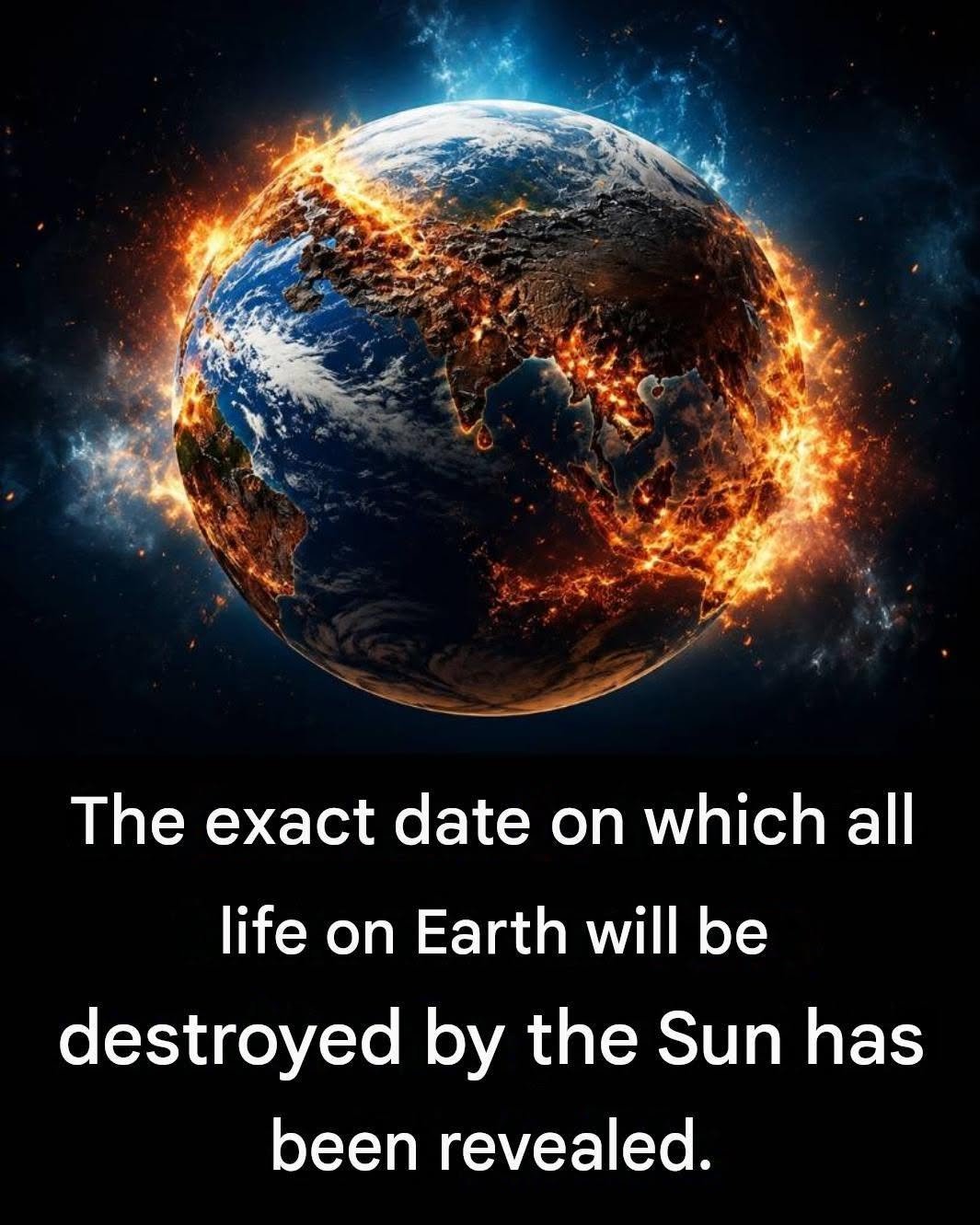
A dramatic headline has been circulating claiming that scientists have finally calculated the exact date when life on Earth will end.
The reality is much more interesting—and much less certain.
Scientists can use models of the Sun’s evolution, Earth’s climate, geology, and atmospheric chemistry to estimate how long Earth could remain naturally habitable.
But there is no scientifically established exact date on which all life on Earth will suddenly disappear.
The Sun Is the Biggest Long-Term Factor
The Sun is gradually becoming brighter as it ages.
This process happens extremely slowly, over billions of years.
As solar brightness increases, Earth will eventually become much hotter. That could trigger major changes to the planet’s climate and water cycle long before the Sun reaches the dramatic stages of its later life.
In other words, Earth’s long-term habitability is expected to end well before the Sun actually becomes a red giant.
Earth Could Become Uninhabitable Before the Sun Dies
One important distinction is often lost in viral headlines:
“Earth becomes uninhabitable” is not the same as “all life on Earth ends.”
As temperatures rise over geological timescales, Earth’s oceans and atmosphere could eventually change dramatically.
Complex life would become increasingly difficult to sustain.
But some microorganisms are extraordinarily resilient.
Life has survived enormous environmental changes throughout Earth’s history, including major climate shifts, mass extinctions, volcanic events, and asteroid impacts.
Scientists therefore cannot simply put a single date on the disappearance of all life.
What Happens to the Oceans?
Over very long timescales, increasing solar energy is expected to accelerate Earth’s water cycle.
More water vapor enters the atmosphere, which can contribute to further warming.
Eventually, Earth’s surface conditions could become too extreme for stable oceans as we know them.
Without abundant liquid water, the planet would become vastly less hospitable to most forms of life.
But exactly how and when these transitions occur depends on complex interactions among the atmosphere, oceans, rocks, and biosphere.
That’s why scientists use models and ranges rather than treating the future as a precisely dated event.
And What Happens to the Sun?
The Sun is currently a middle-aged star.
It won’t remain this way forever.
In roughly 5 billion years, the Sun is expected to exhaust the hydrogen fuel in its core and enter later stages of stellar evolution.
It will eventually expand dramatically into a red giant.
During that stage, the inner Solar System will become an extraordinarily hostile environment.
Mercury and Venus are expected to be engulfed, and Earth may also be engulfed or left as an extremely altered, uninhabitable world.
But this is billions of years in the future—not a prediction about an imminent end of humanity.
What About Humanity?
This is where the science becomes much less predictable.
The eventual evolution of the Sun is governed by well-understood stellar physics.
Human civilization is not.
Scientists cannot reliably predict what humanity—or even our species—will look like millions or billions of years from now.
Our future could be influenced by technological development, climate change, asteroid impacts, pandemics, ecological changes, nuclear conflict, or events we haven’t anticipated.
Those possibilities are fundamentally different from the predictable aging of the Sun.
Does This Mean Earth Has an Expiration Date?
In a very broad sense, yes.
Earth is not expected to remain habitable forever.
But saying:
“Scientists have finally dated the end of life on Earth”
creates a level of precision that the science doesn’t support.
There is no universally accepted calendar date such as:
“Life ends on this particular day.”
Instead, scientists describe long-term evolutionary and environmental processes that will gradually make Earth less suitable for life.
Could Humans Leave Earth?
In principle, an advanced civilization could eventually migrate beyond Earth.
Humanity already has spacecraft operating far beyond our planet, but traveling to another star and establishing a self-sustaining civilization elsewhere is vastly beyond today’s capabilities.
Whether humans—or descendants of humans—could survive for billions of years is therefore an open question.
It’s not something current science can predict.
What About the End of the Universe?
That’s an even bigger question.
The eventual fate of the universe depends on cosmological factors such as dark energy, matter, expansion, and the behavior of fundamental physics.
One commonly discussed possibility is heat death, in which the universe continues expanding and gradually becomes colder and less capable of supporting complex processes.
But that is a story about the universe on enormous timescales, not a specific prediction for Earth’s biological life.
So, When Will Life End?
The honest scientific answer is:
We don’t know an exact date—and science doesn’t currently provide one.
We can make increasingly sophisticated predictions about the Sun’s evolution and Earth’s long-term habitability.
We can also identify conditions that could eventually make Earth unsuitable for most life.
But “the exact day all life ends” is not something scientists have calculated.
The Bigger Perspective
Perhaps the most remarkable part of the story isn’t that Earth supposedly has a countdown.
It’s that Earth has already existed for about 4.5 billion years, and life has survived enormous changes throughout that history.
The planet’s future will also unfold on timescales almost impossible for humans to imagine.
The Sun will change.
Earth will change.
Life will change.
But there is no scientifically established date on the calendar when all life on Earth is destined to disappear.
So when you see a headline claiming that scientists have finally “dated the end of life,” look for the actual research.
The science is usually about probabilities, models, evolutionary timescales, and changing planetary conditions—not a precise doomsday date.
The Bottom Line
Earth will not remain habitable forever, but scientists have not discovered an exact date for the end of all life.
The Sun’s gradual evolution provides a powerful long-term constraint on Earth’s future, while the precise fate and survival of life remain much more uncertain.
Billions of years from now is a very different kind of deadline from tomorrow.
The real scientific story is fascinating enough without turning it into a countdown clock.