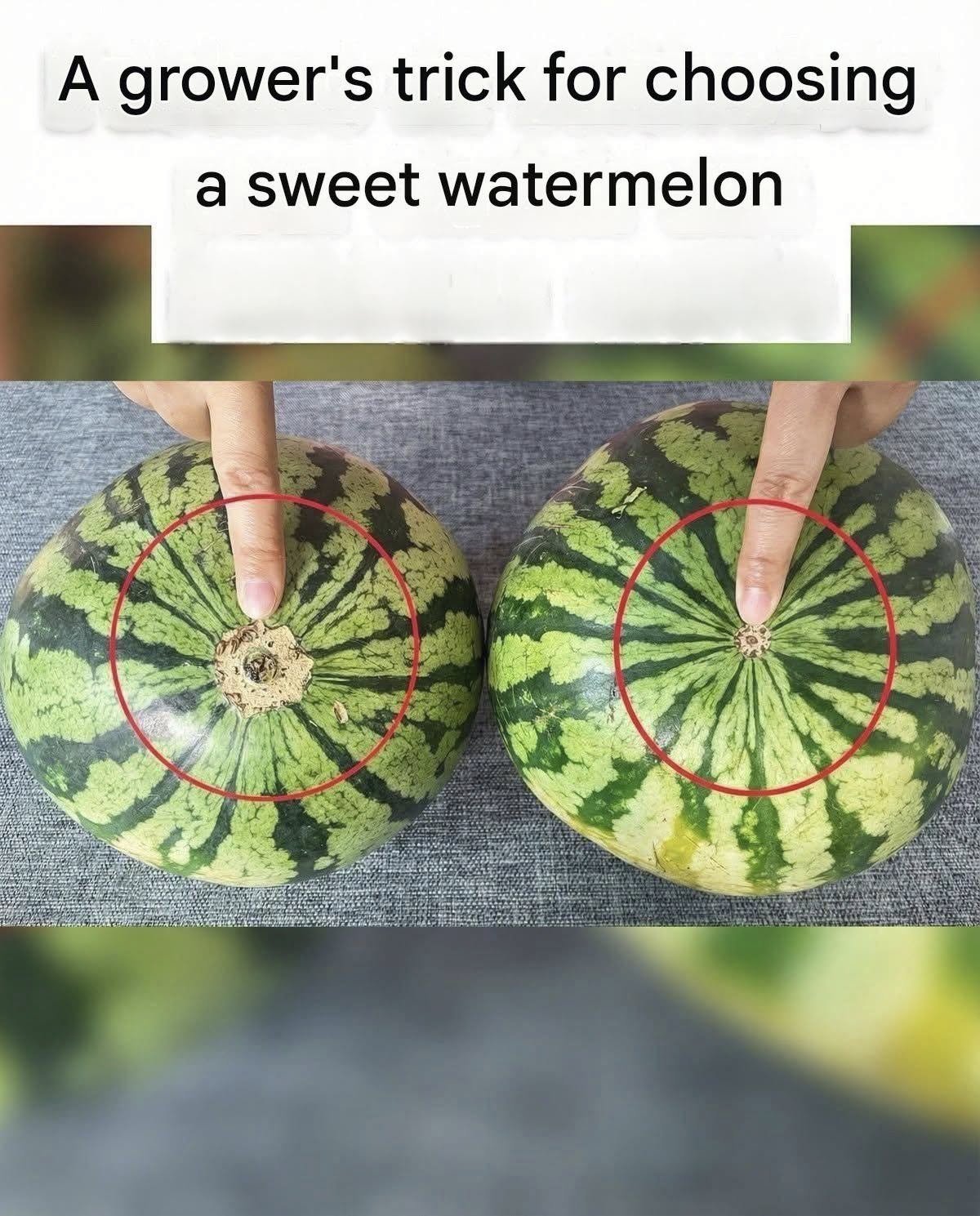
No More Bland Watermelons: How to Pick a Sweet, Ripe One
Here’s the detail first: you can’t guarantee sweetness just by looking at a watermelon, because sugar content varies from fruit to fruit. But several visual clues can help you choose a watermelon that is more likely to be ripe, flavorful, and juicy.
The trick is to look at several signs together rather than relying on one viral rule.
1. Look for a Large Creamy-Yellow Field Spot
This is one of the most useful visual clues.
The field spot is the area where the watermelon rested on the ground while growing. Look for a spot that is creamy yellow, yellow-orange, or deep yellow, rather than white or very pale green.
A well-developed yellow field spot generally indicates that the watermelon spent time ripening on the vine.
2. Don’t Automatically Choose the Greenest Melon
A watermelon with a beautiful, vivid green exterior isn’t necessarily the sweetest.
Instead, look for strong contrast between the lighter and darker green areas on a striped watermelon. The rind should generally look mature rather than unusually pale.
Color alone, however, isn’t enough to determine sweetness.
3. Check the Shape
Choose a watermelon that looks symmetrical and well-formed.
Avoid fruit with major irregular bumps, deep dents, soft collapsed areas, or obvious damage.
An unusual shape doesn’t automatically mean a bad watermelon, but a symmetrical fruit without significant damage is generally an easier choice.
4. Look for a Dry Stem
If the watermelon still has part of its stem attached, a dry, brownish stem can be a useful maturity clue.
A green stem may indicate that the fruit was harvested relatively recently, although stem appearance isn’t a perfect measure of sweetness because handling and storage affect it.
5. Give It a Gentle Knock
The famous “knock test” can provide another clue, although it’s not a scientifically reliable sweetness detector.
A ripe watermelon may produce a relatively deep, resonant sound when tapped.
If it sounds unusually dull or hollow, that can sometimes indicate a problem—but don’t reject a melon based solely on sound.
Think of the tapping test as one clue among several.
6. Pick It Up
This is an underrated trick.
A ripe watermelon should generally feel heavy for its size, because much of its weight comes from water.
Compare similarly sized melons and choose one that feels particularly heavy and solid.
7. Look for Webbing or Brown Marks
Some watermelons have rough, brown, web-like markings on their skin.
These marks are sometimes associated online with sweetness because they can develop where the fruit has experienced certain forms of pollination or physical contact during growth.
However, webbing isn’t a guarantee of high sugar content.
Don’t reject a good watermelon simply because it doesn’t have prominent webbing.
8. Avoid Soft or Sunken Areas
Inspect the entire fruit.
Avoid watermelons with:
- Soft spots
- Deep bruises
- Cracks
- Leaking areas
- Mold
- Sunken patches
- Strong fermented or unpleasant odors
These can indicate damage or spoilage.
9. Don’t Obsess Over Tiny Brown Spots
Small superficial marks aren’t necessarily a problem.
Watermelons can develop harmless cosmetic blemishes during growth and handling.
What matters more is whether the fruit has softness, leaking, mold, deep damage, or other signs of deterioration.
10. The Best Strategy: Combine the Clues
Instead of searching for one magical indicator, use a checklist:
Large creamy-yellow field spot + heavy for its size + symmetrical shape + healthy rind + no soft or damaged areas = a good candidate.
If the watermelon also has a dry stem and sounds reasonably resonant when tapped, that’s additional information—but none of these signs can guarantee a particular sweetness level.
What About the “Sugar Spot” Myth?
You’ll often see claims that certain brown dots or web-like patterns prove a watermelon contains more sugar.
That’s too absolute.
The exterior can provide clues about maturity and growing conditions, but sweetness ultimately depends on the fruit’s variety, growing conditions, maturity at harvest, and other factors.
There is no reliable visual test that lets you measure the exact sugar content of an uncut watermelon.
The Quick Market Test
When you’re standing at the market and don’t want to spend five minutes examining every melon:
First: Find the creamy-yellow field spot.
Second: Pick up two similarly sized melons and choose the heavier one.
Third: Check for a symmetrical shape and firm, undamaged rind.
Fourth: Look at the stem if one is present.
Finally: If everything looks good, choose that melon rather than relying on the tapping sound alone.
Final Takeaway
The big creamy-yellow field spot is one of the easiest clues to look for, while heaviness for size, a healthy rind, and an intact, undamaged fruit can help you make a better selection.
But there is no “sure-fire” visual trick that guarantees a perfectly sweet watermelon every time. Use several signs together, and you’ll have much better odds of avoiding a bland, underripe melon.