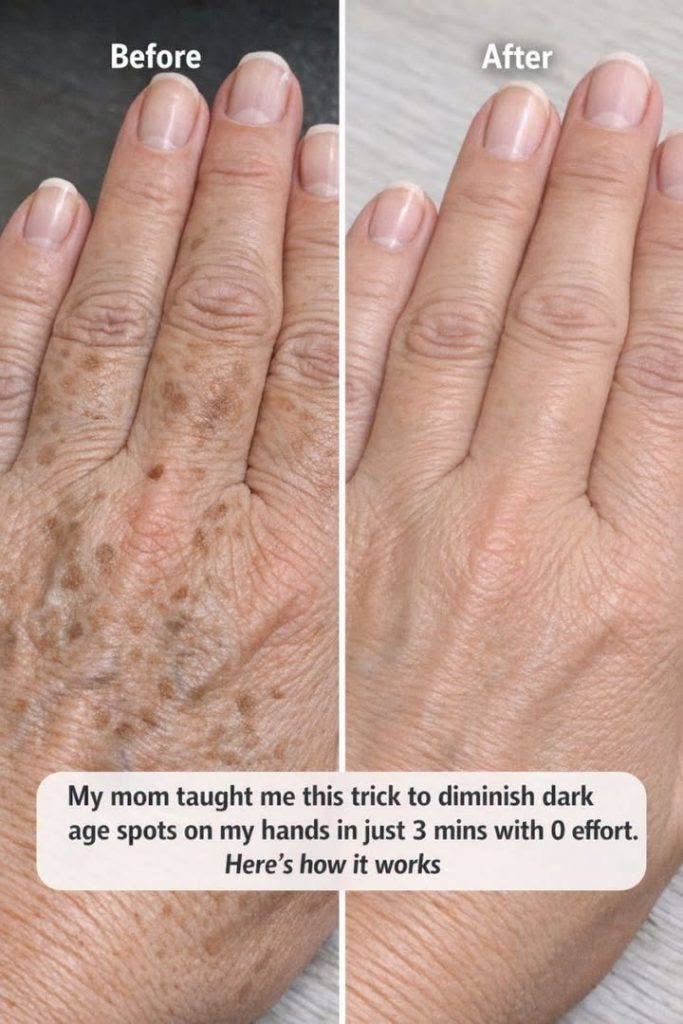
My Mom Taught Me This Trick to Make Dark Age Spots on Your Hands Look Less Noticeable in 3 Minutes
If you want a quick way to make dark spots on your hands look brighter and less noticeable, there are gentle options—but no safe home remedy can actually remove an age spot in three minutes.
Age spots, also called solar lentigines, develop after years of ultraviolet (UV) exposure. They don’t disappear instantly with lemon juice, baking soda, toothpaste, or other viral “hacks.” Some of those remedies can actually irritate or burn the skin and make pigmentation more noticeable.
Here is a safer three-minute approach for temporarily improving their appearance.
1. Wash Your Hands Gently
Start with lukewarm water and a mild, fragrance-free cleanser.
Don’t scrub the spots aggressively. Dark pigmentation sits within the skin, so rubbing harder won’t remove it. Excessive friction can irritate the skin and potentially cause additional discoloration.
Pat your hands dry rather than rubbing them with a towel.
2. Apply a Moisturizer
Apply a simple, fragrance-free hand moisturizer immediately afterward.
When dry skin is moisturized, the surface can look smoother and more reflective, which may make uneven pigmentation appear less prominent.
Look for ingredients such as:
- Ceramides
- Glycerin
- Hyaluronic acid
- Petrolatum
- Dimethicone
This won’t remove the pigment, but it can produce a noticeable cosmetic improvement within minutes.
3. Use Hand Sunscreen
This is arguably the most important step if you want existing age spots to become less noticeable over time.
Apply a broad-spectrum sunscreen with SPF 30 or higher to the backs of your hands and other exposed skin.
UV exposure contributes to age spots and can cause them to become darker. Consistent sun protection helps prevent new pigmentation and can reduce continued darkening.
Remember to reapply when appropriate, particularly after washing your hands frequently.
4. For an Instant Cosmetic Effect, Use Concealer
If you literally want the spots to look less noticeable within a few minutes, cosmetic camouflage is much more realistic than a home “bleaching” remedy.
A small amount of a skin-tone-matched concealer or tinted hand product can temporarily disguise pigmentation.
Blend it gently rather than scrubbing the area.
This changes the appearance, not the underlying pigmentation.
5. Don’t Try Lemon Juice
You may see recipes recommending lemon or lime juice for dark spots.
This is not a good shortcut.
Citrus juice can irritate the skin, and exposure to sunlight after contact with certain citrus compounds can produce phytophotodermatitis, potentially causing redness, blistering, and additional pigmentation.
So the “natural” remedy can actually make the problem worse.
6. Skip Baking Soda and Toothpaste
Baking soda and toothpaste are also frequently promoted as inexpensive skin-lightening treatments.
They’re not designed to treat age spots.
Their abrasive or irritating properties can damage the skin barrier, producing dryness and inflammation. Irritated skin can develop post-inflammatory hyperpigmentation, particularly in people prone to pigmentation.
A product being found in your kitchen doesn’t make it appropriate for your skin.
7. Don’t Scrub the Spots Away
Age spots aren’t simply dirt sitting on the skin.
They are areas of increased pigment associated with long-term UV exposure. Exfoliating aggressively may remove some dead surface cells, but it doesn’t scrub away the underlying pigment safely.
Gentle skincare is a much better approach.
What Can Actually Fade Age Spots?
If you want a long-term reduction rather than a three-minute cosmetic effect, dermatologists have several options.
Retinoids
Topical retinoids can encourage skin-cell turnover and may gradually improve uneven pigmentation.
They can cause dryness and irritation, particularly when first introduced, so they should be used appropriately and combined with good sun protection.
Vitamin C
Topical vitamin C is commonly used as an antioxidant and brightening ingredient.
It may help improve uneven pigmentation over time, although results vary depending on the formulation and concentration.
Hydroquinone
Hydroquinone can lighten certain forms of hyperpigmentation, but its availability and appropriate use vary by country. It should be used according to professional or product guidance because improper or prolonged use can cause skin complications.
Professional Treatments
Dermatologists can treat suitable age spots with procedures such as:
- Laser or light-based treatments
- Cryotherapy
- Chemical peels
- Certain prescription topical treatments
These approaches can produce much more noticeable changes than household remedies, but they also carry risks such as irritation, scarring, or changes in pigmentation and should be selected by a qualified professional.
Don’t Assume Every Dark Spot Is an Age Spot
This is one of the most important points.
A new dark spot on the hand isn’t automatically a harmless age spot.
Have a suspicious or changing spot evaluated, particularly if it:
- Changes size, shape, or color
- Has an irregular border
- Contains multiple colors
- Bleeds or crusts
- Becomes painful or persistently itchy
- Looks substantially different from your other spots
- Appears suddenly without an obvious explanation
Some skin cancers can resemble ordinary pigmented spots in their early stages.
The 3-Minute Routine
If your goal is “make my hands look better right now,” try:
Minute 1: Gently wash and dry your hands.
Minute 2: Apply a rich, fragrance-free moisturizer.
Minute 3: Apply broad-spectrum SPF 30+ and, if desired, a small amount of cosmetic concealer to camouflage the spots.
That’s much safer than applying acidic kitchen ingredients or aggressively scrubbing your skin.
Final Takeaway
There isn’t a safe household ingredient that can erase genuine age spots in three minutes.
But you can make your hands look smoother and the spots less noticeable very quickly with moisturizer and cosmetic camouflage, while daily sunscreen helps prevent further darkening. For actual fading, evidence-based topical treatments or dermatologist-performed procedures generally require weeks to months, not minutes.
And if a “dark age spot” is new, changing, bleeding, or unusual, don’t try to bleach it away—have it checked by a dermatologist first.