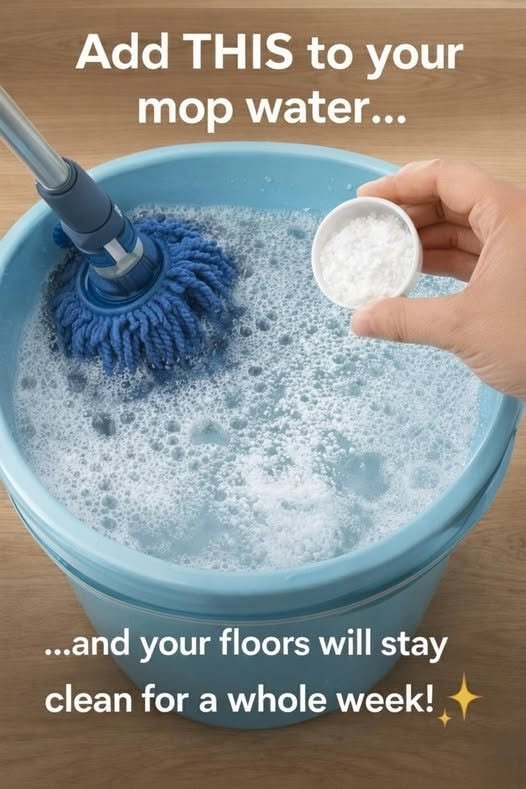
I Didn’t Believe This Floor Trick Until I Tried It… Now I’ll Never Go Back
I thought I knew all the basic tricks for cleaning floors.
Sweep first.
Mop second.
Let the floor dry.
Repeat whenever necessary.
Then I tried one surprisingly simple change to my routine, and I immediately understood why people kept talking about it.
The trick wasn’t an expensive machine or a specialty cleaning gadget.
It was simply changing the way I mop.
Instead of flooding the floor with cleaning solution, I started using a small amount of cleaner diluted according to the product’s instructions, a microfiber mop, and clean water as needed.
The difference was noticeable.
The floor didn’t feel sticky afterward, the microfiber picked up more of the fine dirt, and I wasn’t left wondering why a supposedly clean floor still looked dull when the sunlight hit it.
If your floors often look clean but feel slightly tacky—or if they seem to attract dust immediately after mopping—your cleaning technique may be part of the problem.
The Mistake I Was Making
For years, I assumed that more cleaning solution meant a cleaner floor.
It sounds logical.
If a little cleaner removes dirt, surely more cleaner should remove even more dirt.
Not necessarily.
Using too much product can leave behind residue, particularly when the product isn’t diluted as directed.
That residue can make a floor feel sticky or look cloudy.
It may also attract dust and make the surface appear dirty again surprisingly quickly.
That’s why one of the simplest floor-cleaning improvements is also one of the easiest to overlook:
Use the right amount of cleaner.
Step 1: Remove the Loose Dirt First
Before reaching for the mop, remove loose dirt, crumbs, dust, and hair.
Use a broom, vacuum, or dry microfiber mop that’s suitable for your flooring.
This step matters because wet mopping over loose debris can simply move dirt around.
Fine grit can also act like an abrasive when dragged across some hard flooring surfaces.
You don’t have to spend half an hour sweeping.
A quick pass through the main walking areas can make the wet-cleaning step much more effective.
Step 2: Don’t Turn the Floor Into a Swimming Pool
This was another habit I had to break.
A mop doesn’t need to be dripping wet to clean effectively.
Excess water can be problematic for some flooring materials, particularly wood and laminate flooring.
Instead, use a damp, well-wrung mop when the flooring manufacturer’s care instructions allow wet cleaning.
The goal is to remove dirt without leaving unnecessary moisture behind.
If you’re cleaning a floor that is sensitive to water, follow the manufacturer’s specific instructions.
Step 3: Use a Microfiber Mop
A microfiber mop is one of the simplest upgrades you can make to a cleaning routine.
Microfiber material can collect fine dust and particles while spreading cleaning solution across the floor.
It’s also washable and reusable, which can be more economical than constantly buying disposable cleaning pads.
Use a clean mop head when possible.
One of the worst cleaning habits is using the same dirty mop head throughout the entire house.
You may simply be redistributing what you’ve already picked up.
Step 4: Work in Small Sections
Instead of covering the entire floor with cleaning solution and hoping it dries evenly, work in manageable sections.
Mop one area.
Pick up the loosened dirt.
Then move to the next section.
This is particularly useful in kitchens and entryways, where floors tend to accumulate more grime.
For larger areas, change or rinse the mop head as needed rather than continuing to spread increasingly dirty water.
Step 5: Change the Water When It Gets Dirty
This sounds obvious, but it’s surprisingly easy to forget.
If your bucket water becomes gray or visibly dirty, continuing to mop with it isn’t doing you many favors.
You’re essentially putting some of that suspended dirt back onto the floor.
Fresh water—or a fresh cleaning solution prepared according to the product’s instructions—can make a noticeable difference.
The “Two-Bucket” Version
If you really want to improve your mopping routine, try a two-bucket approach.
Use one bucket for the cleaning solution and another for rinsing the mop.
Dip the mop into the cleaning solution.
Clean a section of floor.
Rinse the mop in the second bucket.
Then return it to the cleaning solution.
This helps keep the cleaning solution cleaner for longer.
You don’t necessarily need two buckets for a quick kitchen cleanup, but it can be useful when cleaning a larger area.
The Secret Is Actually Residue
Here’s the part that surprised me most.
Sometimes a floor looks dirty not because you haven’t cleaned it enough—but because you’re leaving too much product behind.
Over time, repeated applications of excess cleaner can create a buildup.
That buildup can make the surface look dull.
It can also create a slightly sticky feeling under bare feet.
If that sounds familiar, the answer isn’t necessarily stronger cleaner.
You may need to use less product and, if appropriate for your flooring, occasionally clean according to the manufacturer’s recommendations for removing residue.
Don’t mix random household chemicals together in an attempt to strip the floor.
Some combinations can produce dangerous fumes or damage the surface.
What About Vinegar?
This is where many internet floor hacks go wrong.
Vinegar is frequently recommended as a universal household cleaner, but it isn’t suitable for every type of flooring.
Acidic solutions can damage or dull certain natural stone surfaces and may be inappropriate for some finishes.
So don’t assume that because vinegar is inexpensive and popular online, it’s automatically safe for your floor.
Know what your floor is made of first.
Then follow the manufacturer’s care recommendations.
What About Dish Soap?
Another common suggestion is to add dish soap to mop water.
While dish soap can be useful for certain cleaning tasks, using too much can leave a soapy film behind.
If you use a product that isn’t specifically intended for your flooring, you’re taking a gamble with the finish.
A flooring-safe cleaner used according to its label is usually the safer approach.
The Trick That Makes the Biggest Difference
If I had to reduce the entire method to one idea, it would be this:
Stop assuming that more cleaner equals a cleaner floor.
A good cleaning routine is about removing dirt, not coating the floor with cleaning product.
Use the appropriate cleaner.
Measure or dilute it as directed.
Use the right amount of water.
Use a clean microfiber mop.
And don’t keep pushing dirty water across an entire room.
That’s it.
No complicated gadget required.
Don’t Forget Your Mop Head
A dirty mop can undermine the entire process.
If the mop head smells unpleasant, looks dirty, or hasn’t been washed properly, you’re starting the job with a disadvantage.
Wash reusable microfiber pads according to their care instructions.
Avoid using fabric softener if the manufacturer warns against it, since it can interfere with microfiber’s ability to absorb and collect particles.
Have several mop heads available if possible.
That way, you can switch to a clean one rather than trying to clean an entire house with one increasingly dirty pad.
Give High-Traffic Areas More Attention
Not every part of the floor needs the same amount of cleaning.
Entryways, kitchens, hallways, and areas around dining tables generally collect more dirt than rooms that are rarely used.
Instead of repeatedly deep-cleaning the entire house, you can often save time by giving high-traffic areas more frequent attention.
A quick sweep or vacuum may be all that’s needed on many days.
Then do a more thorough wet cleaning when necessary.
One More Trick: Clean From Cleanest to Dirtiest
When cleaning multiple rooms, start with the areas that are relatively clean and finish with the dirtiest spaces.
For example, you might clean a bedroom before the kitchen or entryway.
This reduces the chance of carrying dirt from one area into another.
And if you’re using the same bucket, it gives you another reason to change the water before tackling the dirtiest floor.
Let the Floor Dry Properly
After mopping, allow the floor to dry according to its material and the cleaning product’s instructions.
Good ventilation can help.
Open doors or windows when appropriate, or use ventilation in the room.
Keep people and pets away from a wet floor when there’s a slipping risk.
If a floor consistently stays wet for a long time, use less water and check whether the flooring manufacturer recommends a different cleaning method.
What I Noticed After Changing My Routine
The biggest difference wasn’t that my floors suddenly became magical.
They simply looked and felt cleaner without feeling coated.
The surface felt less sticky.
There was less visible residue.
And because I was using a cleaner more carefully, I wasn’t pouring unnecessary amounts of product into every bucket.
The process also became easier because I wasn’t repeatedly going over the same floor trying to remove streaks.
The Best Floor “Hack” May Be Simplicity
Cleaning advice on the internet can make ordinary chores seem complicated.
One recipe promises perfect floors with baking soda.
Another recommends vinegar.
Another calls for dish soap.
Another suggests adding several products to the same bucket.
You don’t need to follow every viral trick.
In fact, mixing cleaning products can be dangerous.
A straightforward approach is often better:
Remove loose dirt → use the correct floor cleaner → dilute it properly → mop with a clean microfiber head → avoid excess water → let the floor dry.
It’s not glamorous.
But it works with many flooring types when adapted to the manufacturer’s instructions.
Final Thoughts
I used to think a truly clean floor required more water, more scrubbing, and more cleaning solution.
Now I think the opposite.
The goal isn’t to work harder.
It’s to clean smarter.
Use the correct product for your flooring.
Don’t overdo the cleaner.
Don’t soak the floor unnecessarily.
Keep your mop head clean.
Change dirty water.
And remember that a floor covered in cleaning residue isn’t necessarily a cleaner floor.
That simple change can make your routine faster, easier, and more effective.
And once you get used to floors that feel clean instead of sticky, you may never want to go back to the old way.