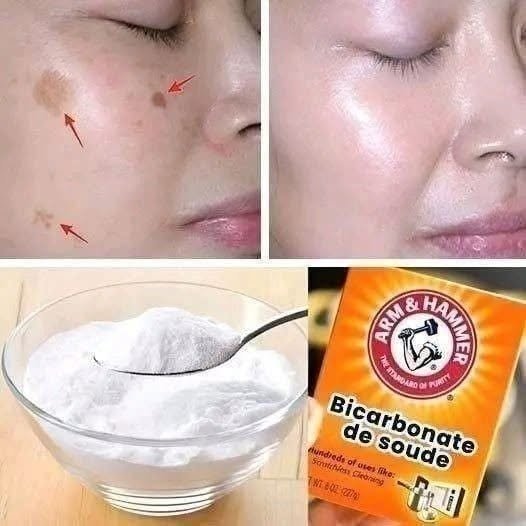
How to Use Baking Soda for Dark Spots, Wrinkles, and Dark Circles — What Actually Works
Baking soda is often promoted online as a cheap “natural” beauty treatment that can supposedly remove dark spots, smooth wrinkles, and lighten dark circles.
But there’s an important catch: baking soda is not a proven treatment for any of these problems, and applying it directly to your face can irritate the skin.
Your facial skin has a protective barrier and a naturally acidic pH. Baking soda is alkaline, and repeated application can disrupt that barrier, causing dryness, burning, redness, and irritation.
So rather than giving you a recipe that could damage your skin, let’s look at what you can safely do instead.
1. Baking Soda Doesn’t Erase Dark Spots
Dark spots can develop after acne, inflammation, sun exposure, hormonal changes, or other skin conditions.
Scrubbing them with baking soda doesn’t remove the underlying pigment.
In fact, irritating the skin can sometimes make pigmentation darker, particularly in people who are prone to post-inflammatory hyperpigmentation.
If you’re trying to fade dark spots, protecting your skin from sunlight is one of the most important steps.
2. Don’t Use Baking Soda as a Facial Scrub
Baking soda particles can feel mildly abrasive.
That may create a temporary sensation of smoother skin, but aggressive exfoliation isn’t necessarily beneficial.
Over-scrubbing can damage the skin barrier and lead to:
- Redness
- Burning
- Dryness
- Peeling
- Increased sensitivity
- More noticeable pigmentation
A product formulated specifically for facial skin is a safer choice if exfoliation is appropriate for you.
3. Wrinkles Need a Different Approach
Baking soda cannot reverse wrinkles.
Fine lines are associated with normal aging, sun exposure, changes in collagen and elastin, and other factors.
A more evidence-based approach includes:
- Daily broad-spectrum sunscreen
- Regular moisturizing
- Avoiding tanning
- Not smoking
- A skincare routine appropriate for your skin type
Certain topical ingredients, such as retinoids, have substantially better evidence for improving signs of photoaging than household baking soda.
If you’re considering a retinoid, ask a dermatologist or other qualified healthcare professional which product is appropriate for you.
4. Dark Circles Have Many Causes
Dark circles aren’t simply “dirt” or dead skin that needs to be scrubbed away.
They can be influenced by:
- Genetics
- Aging
- Thin skin
- Visible blood vessels
- Increased pigmentation
- Allergies
- Lack of sleep
- Dehydration
- Hollowing beneath the eyes
Because the causes differ, one home remedy can’t reliably eliminate all dark circles.
And the skin around the eyes is particularly delicate.
Don’t put baking soda close to your eyes.
5. What About Baking Soda and Lemon?
This combination is particularly popular online.
It’s also a poor choice for facial skin.
Lemon juice can irritate the skin and make it more sensitive to sunlight. Combining irritating ingredients doesn’t make them safer or more effective.
Avoid applying lemon juice or baking soda mixtures to your face, especially around the eyes.
6. A Safer Routine for Dark Spots
If your primary concern is hyperpigmentation, start with the basics.
Morning
Use a gentle cleanser if needed, followed by moisturizer and broad-spectrum sunscreen with SPF 30 or higher.
Sunscreen is crucial because ultraviolet exposure can worsen many types of pigmentation.
Evening
Cleanse gently and use a moisturizer.
Depending on your skin and the cause of the pigmentation, a dermatologist may recommend ingredients such as azelaic acid, retinoids, or other pigment-targeting treatments.
Don’t introduce several active ingredients at once.
7. A Safer Routine for Dry, Fine-Lined Skin
If your skin looks dry and emphasizes fine lines, focus on hydration rather than exfoliating it with baking soda.
Use a gentle cleanser and a moisturizer containing ingredients that support the skin barrier.
During the day, use sunscreen.
At night, an appropriate retinoid may help with photoaging over time, but it can cause irritation when first introduced and isn’t appropriate for everyone.
8. Don’t Scrub the Skin Around Your Eyes
The skin around your eyes is thin and sensitive.
Avoid homemade scrubs made with:
- Baking soda
- Sugar
- Salt
- Lemon juice
- Toothpaste
- Undiluted essential oils
If dark circles persist and bother you, a dermatologist can help determine whether pigmentation, blood vessels, allergies, hollowing, or another factor is responsible.
9. Patch-Test New Skincare Products
Even products designed for the face can cause irritation.
When introducing a new active ingredient, start cautiously and follow the product directions.
If you develop persistent burning, swelling, blistering, or a significant rash, stop using the product and seek medical advice.
A product being labeled “natural” doesn’t guarantee that it’s gentle.
What Can Baking Soda Actually Be Used For?
Baking soda has many legitimate household uses, including cleaning and deodorizing.
That doesn’t mean it belongs in your skincare routine.
Your skin isn’t a kitchen surface that needs to be aggressively scrubbed clean.
The goal of skincare should be to protect the skin barrier while addressing the underlying problem.
When Should Dark Spots Be Checked?
Most dark spots are harmless, but a new or changing pigmented spot deserves attention.
See a dermatologist if a spot:
- Changes in size, shape, or color
- Has an irregular border
- Bleeds or crusts
- Becomes painful or persistently itchy
- Looks noticeably different from your other spots
Don’t attempt to treat a suspicious lesion with baking soda or another home remedy.
The Bottom Line
There is no reliable baking-soda recipe that safely removes dark spots, wrinkles, or dark circles.
Applying baking soda to your face can irritate the skin and potentially make pigmentation problems worse.
Instead:
- Use sunscreen every day.
- Keep your skin moisturized.
- Avoid harsh scrubbing.
- Choose evidence-based skincare ingredients.
- Treat the cause rather than trying to bleach or abrade the skin.
- See a dermatologist if pigmentation is persistent, severe, or changing.
The safest “natural-looking” skin isn’t skin that has been scrubbed aggressively—it’s skin whose protective barrier has been respected and protected.