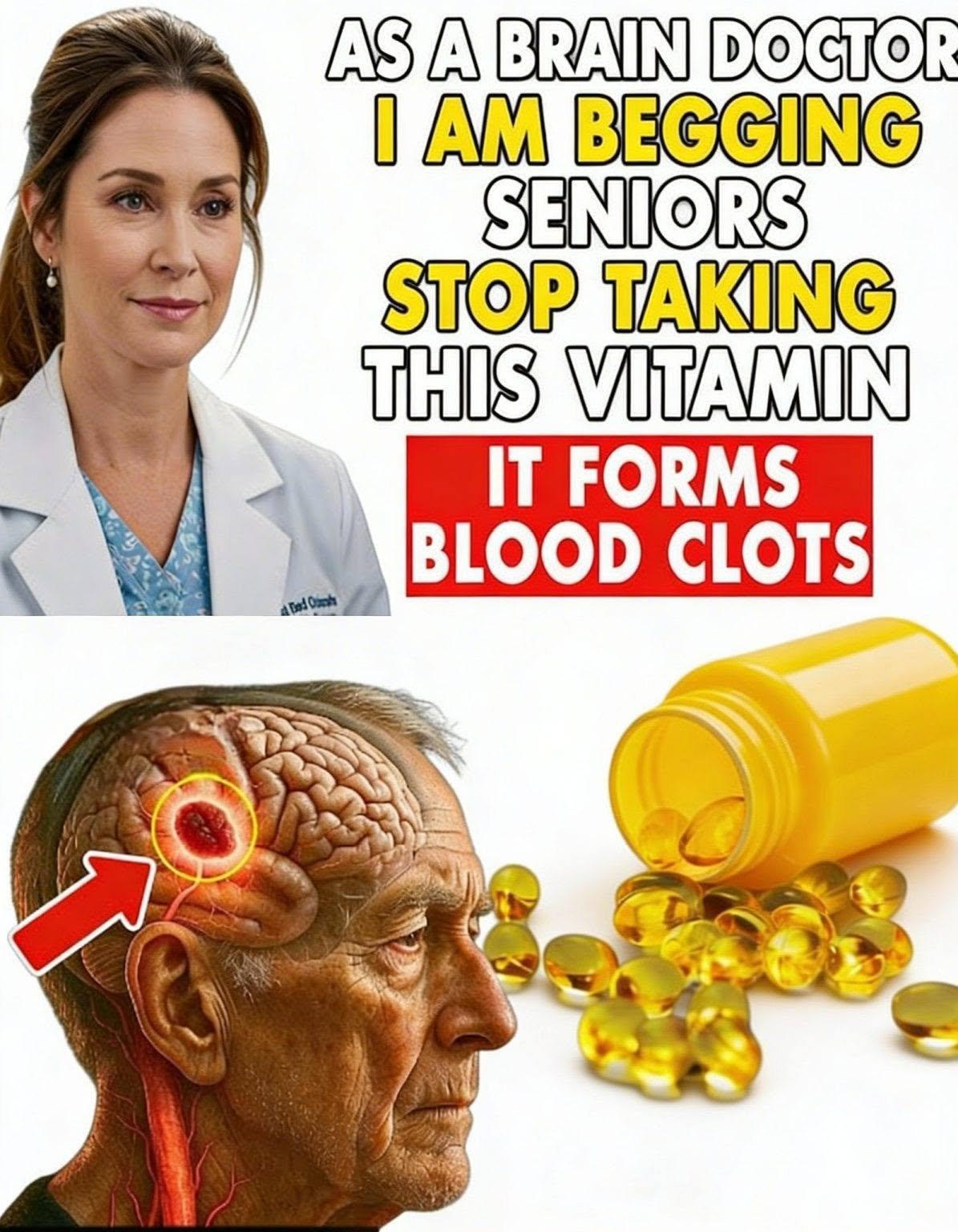
⚠️ “As a Brain Doctor, I’m Shocked: This Vitamin Raises Stroke Risk Overnight” — What’s the Truth?
This headline is misleading. There isn’t good evidence that an ordinary vitamin suddenly raises a person’s stroke risk “overnight.” The effects of vitamins on stroke risk depend on which vitamin, the dose, the person’s health, and whether the nutrient is actually needed.
🧠 Which Vitamin Might the Headline Be Referring To?
One possibility is vitamin E, because research has raised concerns about certain high-dose vitamin E supplements and hemorrhagic stroke (bleeding in the brain).
A large evidence review found limited evidence suggesting vitamin E may increase hemorrhagic-stroke risk. However, this does not mean normal dietary vitamin E or every vitamin-E supplement causes strokes. PubMed+1
Another possibility is a claim about B vitamins, but the evidence does not support the idea that B vitamins generally increase stroke risk. Meta-analyses of randomized trials have found either no significant overall effect or possible reductions in some stroke outcomes. PubMed Central (PMC)+1
🩸 Why the Type of Stroke Matters
There are two major categories:
- Ischemic stroke: a blood vessel supplying the brain becomes blocked.
- Hemorrhagic stroke: a blood vessel ruptures and bleeds into or around the brain.
A supplement could theoretically affect these risks differently, so simply saying “this vitamin causes stroke” is an oversimplification.
👵 What About Older Adults?
Older adults should be particularly cautious about taking high-dose supplements without a specific reason.
The National Institute on Aging recommends discussing supplements with a healthcare professional because supplements can interact with medications and can cause harm at excessive doses. National Institute on Aging
The safest approach is generally to obtain vitamins from food whenever possible and supplement when there is a demonstrated deficiency, medical indication, or professional recommendation.
🚨 Don’t Stop Prescribed Vitamins Suddenly
If a doctor prescribed a vitamin because of a documented deficiency or another medical reason, don’t stop it because of a social-media warning.
The dose matters enormously. A nutritional dose and a high-dose supplement aren’t necessarily equivalent.
🧠 What Actually Has Stronger Evidence for Stroke Prevention?
For older adults, proven stroke-prevention strategies include controlling blood pressure, diabetes, cholesterol, atrial fibrillation, and smoking, along with maintaining a healthy diet and physical activity.
The American Heart Association’s 2024 prevention guidance also recommends a Mediterranean-style dietary pattern for reducing cardiovascular risk. professional.heart.org
Bottom line
No vitamin should be described as something that makes stroke happen “overnight.” Some high-dose supplements may have potential risks, including vitamin E and hemorrhagic stroke, but the evidence is much more nuanced than viral headlines suggest.
If you tell me which vitamin the headline is referring to (vitamin E, D, B12, B6, folic acid, etc.), I can explain the actual evidence, safe doses, and which older adults should be cautious.