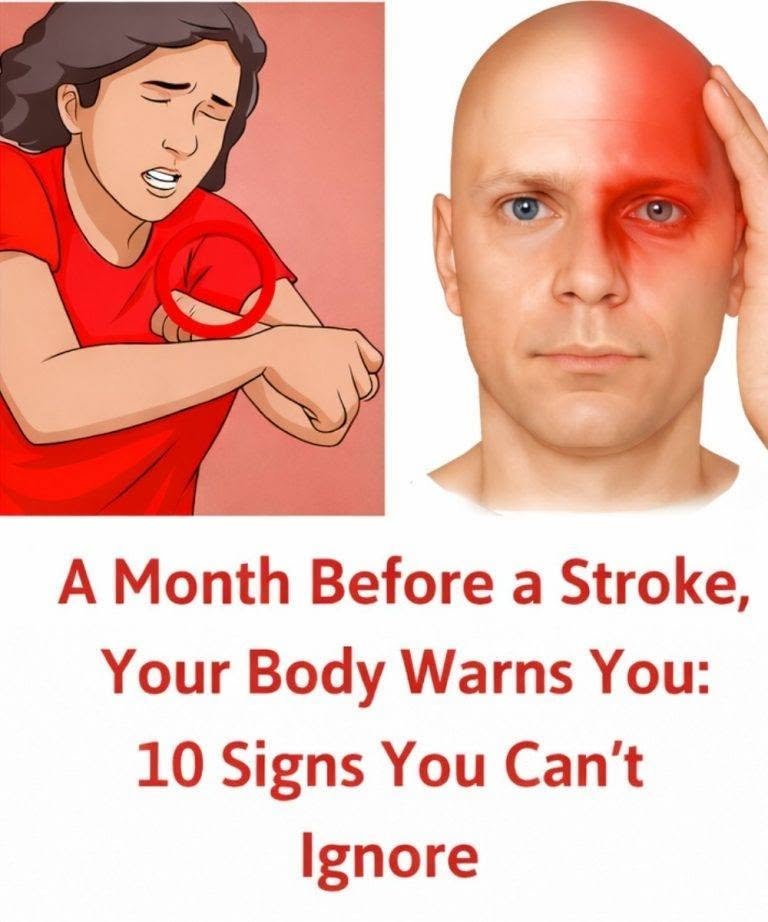
🧠 A Month Before a Stroke, Can Your Body Warn You? 10 Signs You Shouldn’t Ignore
A stroke usually does not give a reliable one-month warning. There isn’t a scientifically established list of 10 symptoms that means a stroke will definitely happen 30 days later.
However, some people experience a transient ischemic attack (TIA)—sometimes called a “mini-stroke”—before a major ischemic stroke. A TIA occurs when blood flow to part of the brain is temporarily interrupted. Its symptoms can disappear within minutes or hours, but it is still a medical emergency and an important warning that a stroke may follow.
So the key message isn’t “your body always warns you a month before.” It’s:
Sudden neurological symptoms—even if they completely disappear—should never be ignored.
🚨 The Most Important Warning Signs
1. Sudden weakness or numbness
Sudden weakness, heaviness, or numbness in the face, arm, or leg, particularly on one side of the body, is a classic stroke warning sign.
For example, someone may suddenly find that their right hand won’t grip properly or that one side of their face feels strange.
Even if the sensation disappears after a few minutes, it needs urgent evaluation.
2. Sudden facial drooping
Ask the person to smile.
If one side of the face suddenly droops or the smile looks uneven, this can be a warning sign of stroke.
Don’t wait to see whether it improves.
3. Sudden difficulty speaking
A person may suddenly:
- Slur their words
- Have trouble finding words
- Say things that don’t make sense
- Have difficulty understanding what someone is saying
Sudden speech or language problems can indicate that part of the brain isn’t receiving enough blood.
4. Sudden vision problems
A stroke or TIA can cause sudden changes in vision, including:
- Loss of vision in one eye
- Double vision
- Blurred vision
- Loss of part of the visual field
Sudden vision loss should be treated as urgent even if it doesn’t hurt.
5. Sudden dizziness or loss of balance
A sudden inability to walk normally, severe dizziness, loss of coordination, or difficulty maintaining balance can sometimes occur with a stroke—particularly when accompanied by other neurological symptoms.
Not every episode of dizziness is a stroke, but sudden, unexplained neurological changes warrant urgent assessment.
6. Sudden severe headache
A sudden, extremely severe headache—especially one that reaches maximum intensity very quickly—can be a warning of a serious brain problem, including hemorrhagic stroke.
It may occur with:
- Vomiting
- Neck stiffness
- Loss of consciousness
- Weakness
- Confusion
- Vision problems
This is an emergency.
7. Sudden confusion
Someone may suddenly become confused or have difficulty understanding what is happening around them.
Sudden confusion is particularly concerning when it occurs together with speech problems, weakness, vision changes, or loss of balance.
8. Sudden trouble walking
A person who suddenly becomes unable to walk normally, veers to one side, or develops unexplained coordination problems should be evaluated urgently.
Don’t assume it is simply fatigue or getting older.
9. Sudden loss of coordination
Difficulty using a hand accurately, dropping objects unexpectedly, or suddenly becoming unable to perform familiar movements can indicate a neurological problem.
Again, the sudden onset is especially important.
10. A brief episode that completely disappears
This is perhaps the most important one to understand.
A person might suddenly experience weakness, speech difficulty, vision loss, or facial drooping—and then feel completely normal again.
That does not necessarily mean everything is fine.
A TIA can produce temporary stroke-like symptoms that resolve because blood flow is restored. A TIA is a that increases stroke risk, take warning event, not something to simply watch at home.
⏱️ Don’t Wait for the Symptoms to Come Back
If stroke symptoms suddenly appear, time matters.
Use the familiar FAST approach:
- F — Face: Is one side of the face drooping?
- A — Arms: Is one arm weak or numb?
- S — Speech: Is speech slurred or unusual?
- T — Time: Get emergency medical help immediately.
Some stroke organizations also emphasize additional symptoms such as sudden severe headache, vision problems, dizziness, and loss of balance.
🚑 What If the Symptoms Go Away?
Still seek urgent medical care.
This is a common and dangerous misconception:
“It only lasted 10 minutes, so it wasn’t serious.”
A temporary episode can be a TIA. The fact that the symptoms disappeared does not make the event harmless.
A healthcare team may need to determine whether there was a TIA and investigate potential causes, such as:
- High blood pressure
- Atrial fibrillation
- Narrowed arteries
- Blood-clotting problems
- Other cardiovascular conditions
Early evaluation can provide an opportunity to reduce the risk of a subsequent stroke.
❤️ Risk Factors Matter Too
You don’t have to wait for symptoms to start before taking stroke prevention seriously.
Risk increases with factors such as:
- High blood pressure
- Diabetes
- High cholesterol
- Smoking
- Atrial fibrillation
- Certain heart conditions
- Previous TIA or stroke
- Physical inactivity
- Obesity
- Increasing age
- Excessive alcohol consumption
High blood pressure is one of the most important modifiable risk factors for stroke.
Regular blood-pressure checks and appropriate treatment can make a major difference.
🥗 What Can You Do to Lower Your Risk?
There is no food, vitamin, tea, or supplement that can guarantee prevention of stroke.
But long-term habits can substantially improve cardiovascular health.
Focus on:
🥦 A balanced diet
Eat plenty of vegetables, fruits, whole grains, legumes, nuts, and other minimally processed foods.
Limit excessive sodium, highly processed foods, and foods high in saturated and trans fats.
🚶 Regular physical activity
Aim for regular movement appropriate for your age and health status.
Walking is an excellent starting point for many people.
🚭 Don’t smoke
Smoking damages blood vessels and substantially increases cardiovascular risk.
💊 Take prescribed medications correctly
If you have high blood pressure, diabetes, high cholesterol, atrial fibrillation, or another condition that increases stroke risk, take prescribed treatment as directed.
Don’t stop blood-pressure medication, anticoagulants, or other cardiovascular medicines simply because you feel well.
🩺 Keep up with medical appointments
Managing blood pressure, cholesterol, blood sugar, and heart rhythm problems can help reduce stroke risk.
⚠️ Don’t Confuse Common Symptoms With Stroke Warnings
Headaches, fatigue, dizziness, tingling, and blurred vision can have many causes.
They don’t automatically mean a stroke is coming.
The symptoms that deserve particular attention are those that are sudden and neurological, especially:
face drooping + arm weakness + speech difficulty + sudden vision, balance, or coordination problems.
That’s much more meaningful than having an ordinary headache or feeling tired for several weeks.
🚨 The Bottom Line
There is no reliable 10-sign checklist that predicts a stroke exactly one month in advance.
But your body can sometimes produce a very important warning: a TIA or other sudden stroke-like neurological episode.
If you suddenly develop facial drooping, weakness or numbness on one side, speech difficulty, vision loss, severe unexplained balance problems, or another sudden neurological change, treat it as an emergency—even if the symptoms disappear.
Don’t wait for tomorrow. Don’t wait for another episode. Don’t wait for a month.
Getting emergency medical attention quickly can be critical because some strokes have treatments that are most effective when given as soon as possible.