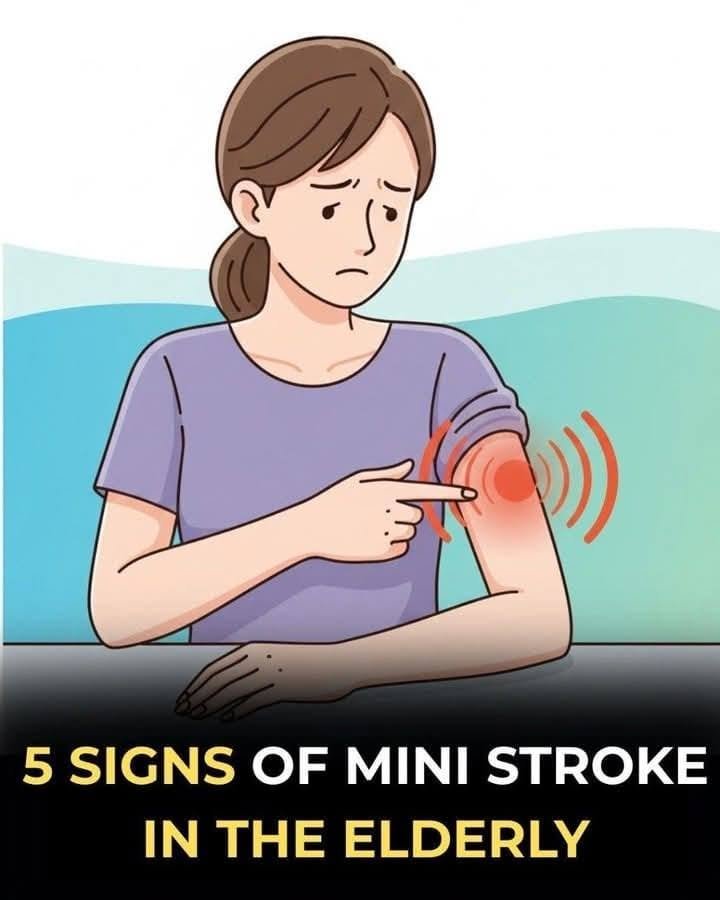
5 SIGNS OF A MINI-STROKE IN OLDER ADULTS YOU SHOULD NEVER IGNORE
A “mini-stroke” is commonly used to describe a transient ischemic attack (TIA). A TIA happens when blood flow to part of the brain is temporarily interrupted, causing stroke-like symptoms that may disappear within minutes or hours.
The word “mini” can be misleading.
A TIA should be treated as a warning of a possible future stroke, and someone experiencing these symptoms needs urgent medical assessment—even if they feel completely normal again.
1. Sudden Weakness or Numbness
One of the most important warning signs is sudden weakness, numbness, or loss of sensation.
It may affect the face, arm, or leg, particularly on one side of the body.
For example, an older adult may suddenly notice that one arm feels weak or that they cannot raise both arms equally.
Facial drooping can also occur. Ask the person to smile and look for an uneven smile or one side of the face appearing to droop.
These symptoms should never be dismissed as ordinary aging.
2. Sudden Trouble Speaking or Understanding
A TIA can temporarily affect the brain areas responsible for language.
Someone may suddenly:
- Slur their speech
- Have difficulty finding words
- Say things that don’t make sense
- Struggle to understand what someone is saying
- Suddenly have difficulty communicating
A person who suddenly becomes unable to speak normally needs urgent assessment, even if their speech returns to normal shortly afterward.
3. Sudden Vision Problems
Temporary vision changes can also occur during a TIA.
Someone might suddenly lose vision in one eye, experience double vision, or develop a significant disturbance in their visual field.
Because vision problems can have many causes, they shouldn’t automatically be assumed to be a TIA.
But sudden unexplained vision loss or a major change in vision requires urgent medical evaluation.
4. Sudden Trouble Walking or Loss of Balance
A TIA can affect areas of the brain involved in coordination and balance.
The person may suddenly become unsteady, have difficulty walking, feel as though the room is spinning, or have trouble coordinating their movements.
An older adult who suddenly becomes unable to walk normally should be assessed urgently, particularly if the change occurs alongside weakness, speech problems, or vision changes.
Don’t simply assume it is “just dizziness” or an ordinary fall.
5. A Sudden, Severe or Unusual Headache
A sudden, severe headache—especially one that is dramatically different from previous headaches—can be a warning sign of a serious neurological problem.
A severe headache accompanied by weakness, confusion, speech problems, vision changes, vomiting, or loss of consciousness requires emergency medical attention.
Not every TIA causes a headache, so the absence of headache doesn’t rule one out.
Remember FAST
One easy way to remember several major stroke warning signs is FAST:
F — Face: Is one side of the face drooping?
A — Arms: Is one arm weak or drifting downward?
S — Speech: Is speech slurred, strange, or difficult?
T — Time: Call emergency medical services immediately.
If any of these symptoms suddenly appear, don’t wait to see whether they go away.
A TIA may resolve, but the risk of a subsequent stroke can remain.
What Should You Do If Symptoms Disappear?
This is one of the most important points.
If someone suddenly develops stroke-like symptoms and then appears completely normal a short time later, that does not mean everything is fine.
It could have been a TIA.
The person still needs urgent medical evaluation because doctors may be able to identify the cause and reduce the risk of a future stroke.
Don’t drive the person yourself if emergency medical services are available. Emergency responders can begin assessment and arrange appropriate care while transporting the patient.
Why Older Adults Need to Take These Symptoms Seriously
The risk of stroke increases with age, although a TIA can happen to younger people as well.
Risk can also be affected by conditions such as high blood pressure, diabetes, high cholesterol, smoking, atrial fibrillation, and previous stroke or TIA.
However, you should never wait for someone to have several risk factors before taking symptoms seriously.
A sudden neurological change is enough reason to seek emergency help.
What Not to Do
Don’t give someone food, drink, or medication simply because you suspect a stroke.
Don’t tell them to lie down and “sleep it off.”
Don’t wait several hours because the symptoms appear mild.
And don’t assume that symptoms disappearing means the danger has passed.
The priority is getting emergency medical assessment as quickly as possible.
The Bottom Line
The five important warning signs include:
- Sudden weakness or numbness, particularly on one side
- Sudden difficulty speaking or understanding
- Sudden vision problems
- Sudden difficulty walking, dizziness, or loss of balance
- Sudden severe or unusual headache
A TIA is not something to ignore simply because the symptoms disappear.
If these symptoms are happening right now, treat them as an emergency and contact your local emergency medical service immediately. Early treatment can be critical when a true stroke is occurring.