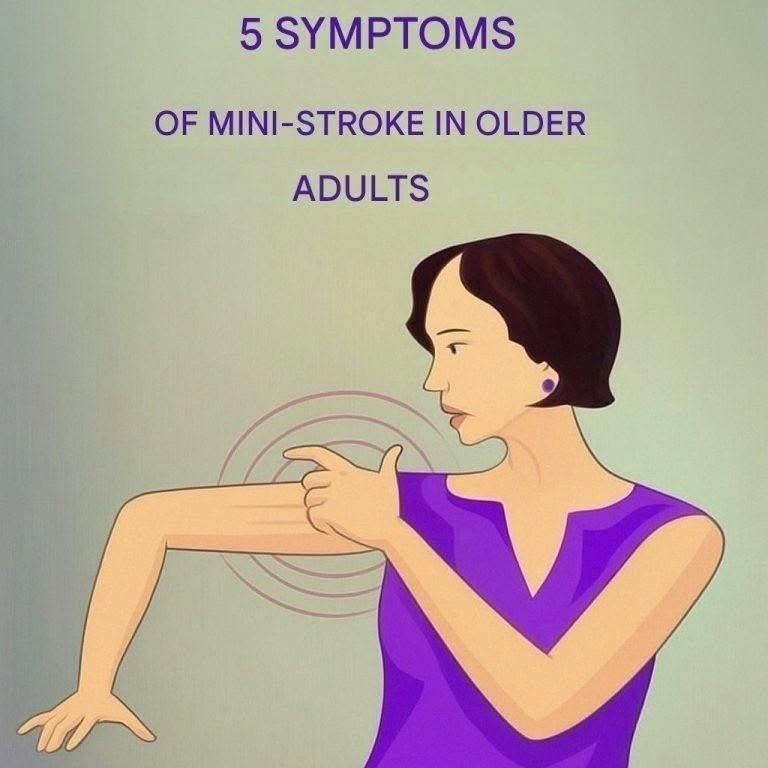
5 Symptoms of a Mini-Stroke in Older Adults That Should Never Be Ignored
A “mini-stroke” usually refers to a transient ischemic attack (TIA). A TIA happens when blood flow to part of the brain is temporarily interrupted. The symptoms can disappear within minutes or hours, but that does not make the event harmless.
A TIA can be a warning that a major stroke may follow, so sudden neurological symptoms should be treated as an emergency even if they completely disappear.
1. Sudden Weakness or Numbness
One of the most important warning signs is sudden weakness, numbness, or loss of coordination—particularly on one side of the body.
You might notice:
- One arm suddenly feels weak or heavy.
- One side of the face becomes numb or droops.
- A leg suddenly becomes difficult to control.
- You have unexpected difficulty walking or maintaining balance.
The symptom may disappear during a TIA, but you should still seek emergency medical attention.
2. Sudden Trouble Speaking or Understanding
A person experiencing a TIA may suddenly have difficulty speaking clearly, finding words, or understanding what other people are saying.
Their speech might become slurred or they may produce words that don’t make sense.
This can be especially noticeable when it happens to someone who normally communicates without difficulty.
Don’t wait to see whether speech returns to normal. Sudden language problems can be a sign of stroke.
3. Sudden Vision Changes
A TIA can temporarily affect vision.
Someone may suddenly experience:
- Loss of vision in one eye
- Double vision
- Blurred vision
- Loss of part of the visual field
Sudden vision loss—particularly in one eye—should be evaluated urgently, even if vision returns to normal.
4. Sudden Dizziness, Loss of Balance, or Difficulty Walking
A sudden inability to walk normally, severe dizziness, loss of coordination, or unexplained trouble maintaining balance can occur with a TIA or stroke.
This can sometimes be mistaken for an inner-ear problem or ordinary weakness.
The sudden onset is particularly important. New neurological symptoms should not simply be attributed to aging.
5. Sudden Severe Headache
A sudden, unusually severe headache can occur with certain types of stroke.
A particularly concerning headache is one that reaches maximum intensity very quickly or is dramatically different from previous headaches.
Severe headache accompanied by weakness, confusion, vision problems, vomiting, loss of consciousness, or difficulty speaking requires emergency evaluation.
Think FAST
A useful way to remember major stroke warning signs is FAST:
- F — Face: Is one side of the face drooping?
- A — Arms: Can the person raise both arms normally?
- S — Speech: Is speech suddenly slurred, confused, or difficult?
- T — Time: Call emergency medical services immediately.
Other sudden symptoms—especially vision loss, severe imbalance, or neurological changes—also warrant emergency assessment.
Don’t Wait for Symptoms to Disappear
This is perhaps the most important point.
A TIA can resolve completely, but you cannot reliably determine at home whether an episode was a TIA or a stroke.
If symptoms are occurring now, call your local emergency service rather than driving yourself to the hospital.
If symptoms have already disappeared, urgent medical evaluation is still important because the risk of a subsequent stroke can be significant, particularly in the hours and days following a TIA.
What Increases the Risk?
TIA and stroke risk increases with factors such as:
- High blood pressure
- Atrial fibrillation
- Diabetes
- High cholesterol
- Smoking
- Previous TIA or stroke
- Certain heart and blood-vessel conditions
- Increasing age
Having one or more risk factors doesn’t mean a stroke will occur, but controlling them can substantially reduce risk.
Final Takeaway
The most important signs are sudden one-sided weakness or numbness, speech or comprehension problems, vision changes, sudden balance or walking difficulties, and unusual severe headache.
A “mini-stroke” is not something to watch at home. Even when symptoms disappear, it can be an urgent warning of a possible major stroke.
If someone suddenly develops stroke-like symptoms, seek emergency medical care immediately.