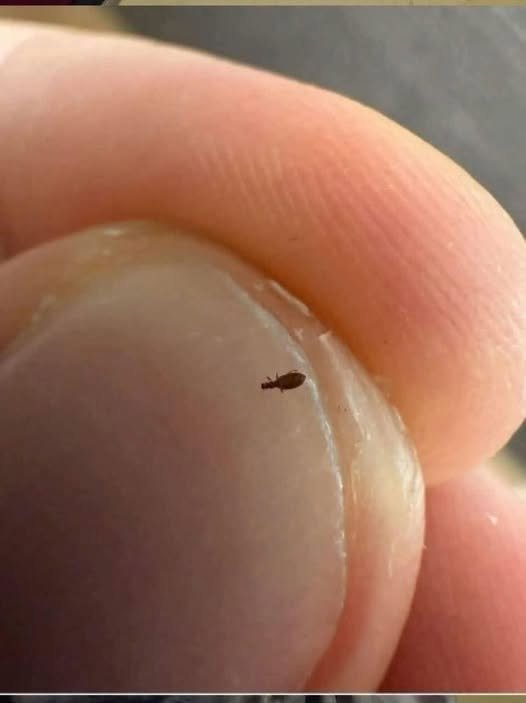
🔍 What the insect looks like
The insect is very small—roughly a few millimeters long relative to the fingernail. I can make out:
-
A dark brown/reddish-brown body
-
A somewhat elongated/oval abdomen
-
A relatively small head
-
Several small legs projecting from the sides
-
Possible antennae
-
It appears to be sitting on the nail, rather than being attached to the skin
🪳 Is it a head louse?
It does not look like a typical head louse to me.
A human head louse (Pediculus humanus capitis) normally has a characteristic:
-
Flattened, elongated body
-
Pale gray, tan, or brown coloration
-
6 prominent legs, each ending in a claw adapted for gripping hair
-
Body approximately 2–3 mm long
-
No wings
Your insect looks somewhat more beetle-like/compact than the classic louse shape. However, the image is not sufficiently sharp to rule a louse out with certainty.
🦟 Could it be a flea?
Possible, but not my first choice. Fleas have:
-
A strongly flattened body
-
Very prominent hind legs
-
A dark brown color
-
A body adapted for jumping
I don’t see the characteristic oversized hind legs that would make me strongly suspect a flea.
🪲 Could it be a tiny beetle?
Yes. This is one of the possibilities I’d consider seriously. The dark, somewhat oval body and apparent antennae are compatible with a tiny beetle or another incidental insect.
Importantly, finding a single insect in someone’s hair does not automatically mean they have head lice. An insect can simply land in or become trapped in hair.
🧴 How to determine whether your friend actually has lice
Don’t rely on this photograph alone. Check the scalp and hair:
Look particularly closely at:
-
Behind both ears
-
The hairline at the back of the neck
-
Close to the scalp
-
Areas where hair is thick
A live crawling louse is the strongest evidence of an active infestation.
Nits (lice eggs) are different from dandruff: they are firmly attached to individual hairs, usually very close to the scalp, and don’t easily slide off when you run a finger along the hair.
⚠️ One important clue
If this insect was found crawling through the hair, rather than being attached to a hair shaft, that makes the situation more ambiguous. If your friend has multiple similar insects, itching, or visible eggs attached to hairs, then lice become much more likely.
My best visual assessment from this particular photograph: it is not an obvious head louse, and I would not recommend treating for lice based solely on this picture.
If you can upload 2–3 clearer photos of the insect (especially one straight from above, with it next to a ruler or coin for scale), I can give you a much more specific identification and explain the features that distinguish it from a head louse, flea, bed bug, and other tiny insects.