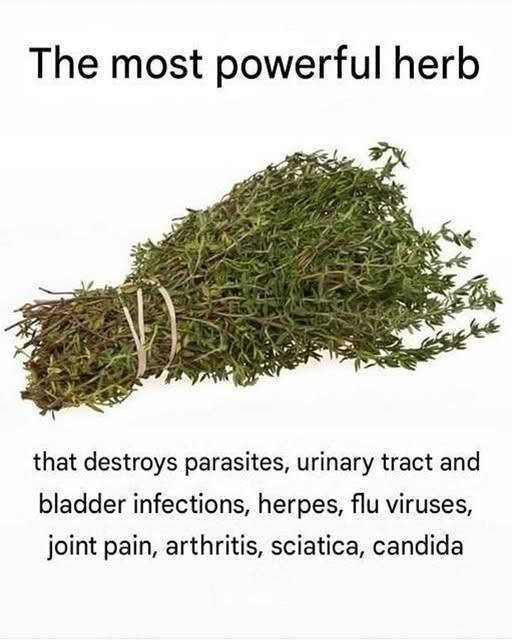
“The Most Potent Herb” for Parasites, UTIs, Herpes and Flu: What the Evidence Really Says
You may have seen claims that one powerful herb can destroy parasites, urinary-tract and bladder infections, herpes, and flu viruses. The problem is that this is not supported by good clinical evidence.
There is no single herb proven to cure all four categories of infection. These illnesses can have completely different causes and require different treatments.
1. Urinary Tract and Bladder Infections
A urinary tract infection is usually caused by bacteria, and a bladder infection can sometimes progress to a kidney infection.
The CDC states that antibiotics are used to treat UTIs, with the appropriate treatment depending on the individual infection. CDC+1
Some natural products may have a role in prevention, but that is very different from treating an established infection.
What about cranberry?
Cranberry is one of the better-studied natural products for recurrent UTIs. Research suggests it may reduce the risk of recurrent symptomatic UTIs in some women, but the evidence is inconsistent.
Importantly, cranberry is not recommended as a treatment for an existing UTI. NCCIH+1
2. Herpes
Herpes is caused by herpes simplex viruses (HSV-1 or HSV-2).
There are prescription antiviral medicines that can reduce the severity and duration of outbreaks and help reduce transmission risk in appropriate circumstances. No herb has been established as a replacement for these treatments.
An herb showing antiviral activity in a laboratory experiment does not necessarily mean that consuming the herb will eliminate herpes in a person.
3. Influenza (Flu)
The evidence is also important here.
The CDC recommends prescription antiviral medicines for appropriate people with influenza, particularly those who are hospitalized, severely ill, or at increased risk of complications. They work best when started early, ideally within about 48 hours of symptom onset. CDC+1
Some herbs have been studied for flu symptoms. For example, preliminary research suggests that elderberry might help with some cold or flu symptoms, but the evidence is limited. NCCIH+1
That is very different from saying elderberry—or another herb—destroys flu viruses.
4. Parasites
“Parasites” covers many different organisms, including intestinal worms and protozoa. Because the organisms are different, treatment is also different.
Some plants have demonstrated antiparasitic activity in laboratory or animal research, but this does not establish that an herbal preparation can safely eradicate a human parasitic infection.
If a parasite infection is suspected, identifying the specific parasite is important because the appropriate medication depends on what is causing the infection.
Why These “Miracle Herb” Claims Are Misleading
The confusion often comes from laboratory research.
An herb might contain a compound that kills or inhibits a microorganism in a test tube. But that doesn’t prove that drinking a tea or taking an extract will produce the same concentration in human tissues.
There are several additional questions:
- Is the active compound absorbed into the bloodstream?
- Does it reach the infected tissue?
- What dose is effective?
- Is that dose safe?
- Does it interact with medications?
- Does it actually cure the infection in controlled human trials?
Without good human clinical evidence, we shouldn’t call an herb a cure.
A Safer Way to Think About Herbs
Some herbs can be useful as food, supportive remedies, or potentially preventive measures, but they shouldn’t replace proven treatment for potentially serious infections.
For example:
| Problem | Evidence-based approach |
|---|---|
| Existing bacterial UTI | Medical evaluation and appropriate treatment |
| Recurrent UTI prevention | Certain measures, including cranberry in some women |
| Influenza | Early antiviral treatment when indicated |
| Herpes | Appropriate antiviral therapy when indicated |
| Suspected parasite | Identify the parasite and use appropriate antiparasitic treatment |
When You Shouldn’t Wait for an Herbal Remedy
Seek medical care promptly for a suspected UTI accompanied by fever, chills, back/flank pain, vomiting, confusion, or feeling very unwell, because infection can spread to the kidneys or bloodstream.
Likewise, people at higher risk of serious influenza complications should contact a healthcare professional promptly when flu symptoms begin; early antiviral treatment can be important. CDC
Bottom Line
There isn’t a scientifically established “most potent herb” that destroys parasites, UTIs, bladder infections, herpes, and flu viruses.
Some plants—including cranberry and elderberry—have interesting evidence for particular purposes, but their effects should not be exaggerated. Most importantly, don’t use an herbal remedy instead of appropriate treatment for an established infection, particularly a UTI or serious flu illness. NCCIH+1