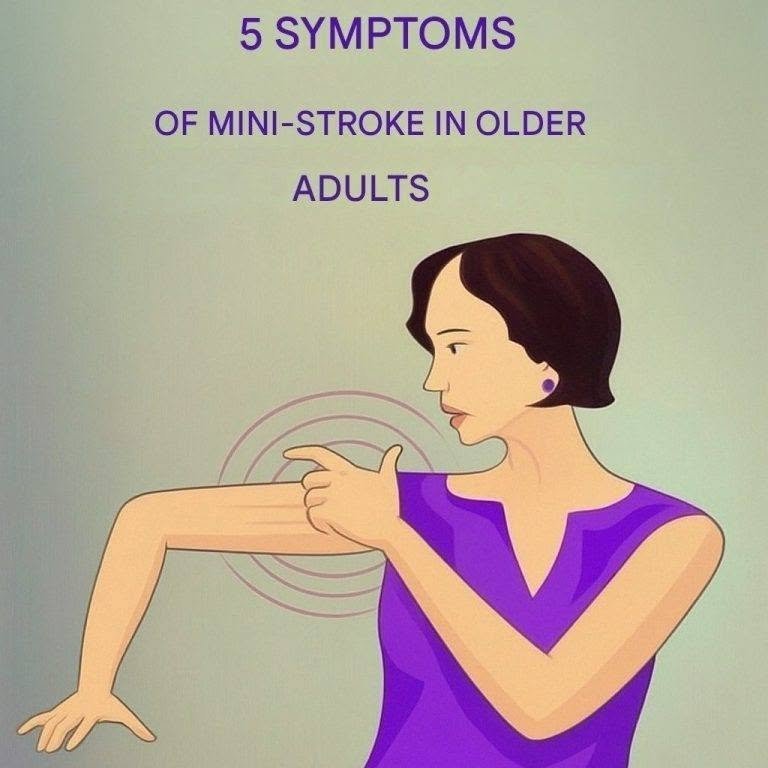
5 Symptoms of a Mini-Stroke in Seniors That Shouldn’t Be Ignored
A “mini-stroke” is usually called a transient ischemic attack (TIA). It happens when blood flow to part of the brain is temporarily interrupted, producing symptoms similar to a stroke. The symptoms may disappear after a few minutes or hours, but that does not mean the event was harmless. A TIA is considered a warning stroke because it can signal a risk of a more serious stroke. www.stroke.org+1
This is especially important for older adults because stroke risk increases with age. If a senior suddenly develops any of the symptoms below, don’t wait to see whether they go away.
1. Sudden Weakness or Numbness
One of the classic warning signs is sudden weakness, numbness, or loss of movement in the face, arm, or leg, particularly on one side of the body.
For example, a person might suddenly notice that:
- One arm feels unusually heavy.
- They cannot grip something properly.
- One side of the face feels numb.
- One leg suddenly becomes difficult to control.
- Their smile becomes uneven.
The symptom can be surprisingly subtle. An older person might simply say, “My hand feels strange” or suddenly drop something they were holding.
Even if the strength returns completely, it should not be dismissed. Temporary neurological symptoms can be caused by a TIA and require urgent assessment. www.stroke.org+1
2. Sudden Trouble Speaking or Understanding
Another major warning sign is a sudden change in speech or language.
A person might suddenly:
- Slur their words
- Struggle to find simple words
- Speak in a way that doesn’t make sense
- Have difficulty understanding what others are saying
- Suddenly be unable to communicate normally
Sometimes family members notice the change before the person experiencing it does.
Don’t assume that confusion or strange speech is simply part of getting older. A sudden change is very different from the gradual memory problems that can occur with aging or dementia.
If speech suddenly becomes abnormal, treat it as a potential stroke or TIA. www.stroke.org+1
3. Sudden Vision Changes
A TIA can affect the areas of the brain responsible for vision or the blood supply to the eye.
Warning signs can include sudden:
- Blurred vision
- Double vision
- Partial loss of vision
- Complete loss of vision in one eye
- Difficulty seeing normally
Someone might describe it as a curtain or shadow coming over part of their vision.
Don’t automatically assume that a sudden visual change is simply an eye problem, especially in an older adult with cardiovascular risk factors.
Sudden vision problems are included among recognized stroke and TIA warning signs. www.stroke.org+1
4. Sudden Dizziness, Loss of Balance, or Difficulty Walking
An older person who suddenly becomes dizzy, unsteady, or unable to walk normally may be experiencing a neurological emergency.
They may suddenly:
- Stumble
- Ve—particularly when accompanied by vision, speech, weakness, or coordination problems—should be treated seriously. er to one side
- Have trouble standing
- Lose coordination
- Feel as though the room is spinning
- Become unable to walk safely
Balance problems can have many causes, including inner-ear disorders, low blood pressure, medication effects, dehydration, and other conditions.
But sudden loss of balance—particularly when accompanied by vision, speech, weakness, or coordination problems—should be treated seriously. www.stroke.org+1
5. Sudden, Severe Headache
A sudden and unusually severe headache can also be a warning sign of a stroke or another serious neurological problem.
This is particularly concerning when the headache:
- Appears suddenly
- Is unlike previous headaches
- Is extremely severe
- Occurs with confusion
- Occurs with weakness or numbness
- Occurs with vision or speech problems
- Is accompanied by vomiting or loss of consciousness
Not every severe headache is related to a stroke, but a sudden unexplained severe headache shouldn’t be diagnosed at home. www.stroke.org+1
Remember B.E. F.A.S.T.
A useful way to remember several major stroke warning signs is B.E. F.A.S.T.:
B — Balance: Is there sudden loss of balance or coordination?
E — Eyes: Is there sudden vision loss or another sudden vision change?
F — Face: Does one side of the face droop?
A — Arms: Is one arm weak or numb?
S — Speech: Is speech suddenly slurred, confused, or difficult to understand?
T — Time: Call your local emergency service immediately.
The American Stroke Association emphasizes that stroke is an emergency and that treatment is time-sensitive. www.stroke.org+1
What If the Symptoms Disappear?
This is where people make one of the most dangerous mistakes.
Someone may suddenly develop weakness or speech difficulty, feel better after 10 or 20 minutes, and decide:
“I’m fine now. I’ll call the doctor tomorrow.”
Don’t do that.
A TIA can cause temporary symptoms that disappear, but it may be a warning that a more serious stroke is coming. The American Stroke Association recommends immediate medical assessment even when the symptoms have resolved. www.stroke.org+1
The person should be medically evaluated rather than simply monitored at home.
Why Seniors Should Take These Symptoms Seriously
Older adults may already have conditions that increase stroke risk, including high blood pressure, diabetes, heart disease, atrial fibrillation, or a previous stroke or TIA. Age itself is also an important risk factor. www.stroke.org+1
But stroke isn’t an inevitable part of aging.
Many important risk factors can be managed, including blood pressure, diabetes, smoking, cholesterol, physical inactivity, and certain heart conditions.
That’s why recognizing a warning event can provide an important opportunity for medical evaluation and prevention.
What Should You Do?
If a senior suddenly develops weakness, numbness, facial drooping, speech difficulty, vision changes, severe unexplained headache, or sudden loss of balance:
Call your local emergency medical service immediately.
Don’t wait for symptoms to become worse.
Don’t assume that improvement means the danger has passed.
And note when the symptoms first started—or the last time the person was known to be completely normal. That information can be important to the medical team.
The Bottom Line
A “mini-stroke” isn’t something to ignore simply because the symptoms disappear.
The five major warning symptoms to remember are:
- Sudden weakness or numbness, especially on one side
- Sudden speech or language problems
- Sudden vision changes
- Sudden dizziness, balance problems, or difficulty walking
- Sudden severe or unusual headache
These symptoms can have other causes, but you cannot safely determine at home whether they’re a TIA or stroke.
If symptoms appear suddenly, act immediately—even if they disappear. When it comes to stroke, waiting can cost valuable time. www.stroke.org+1