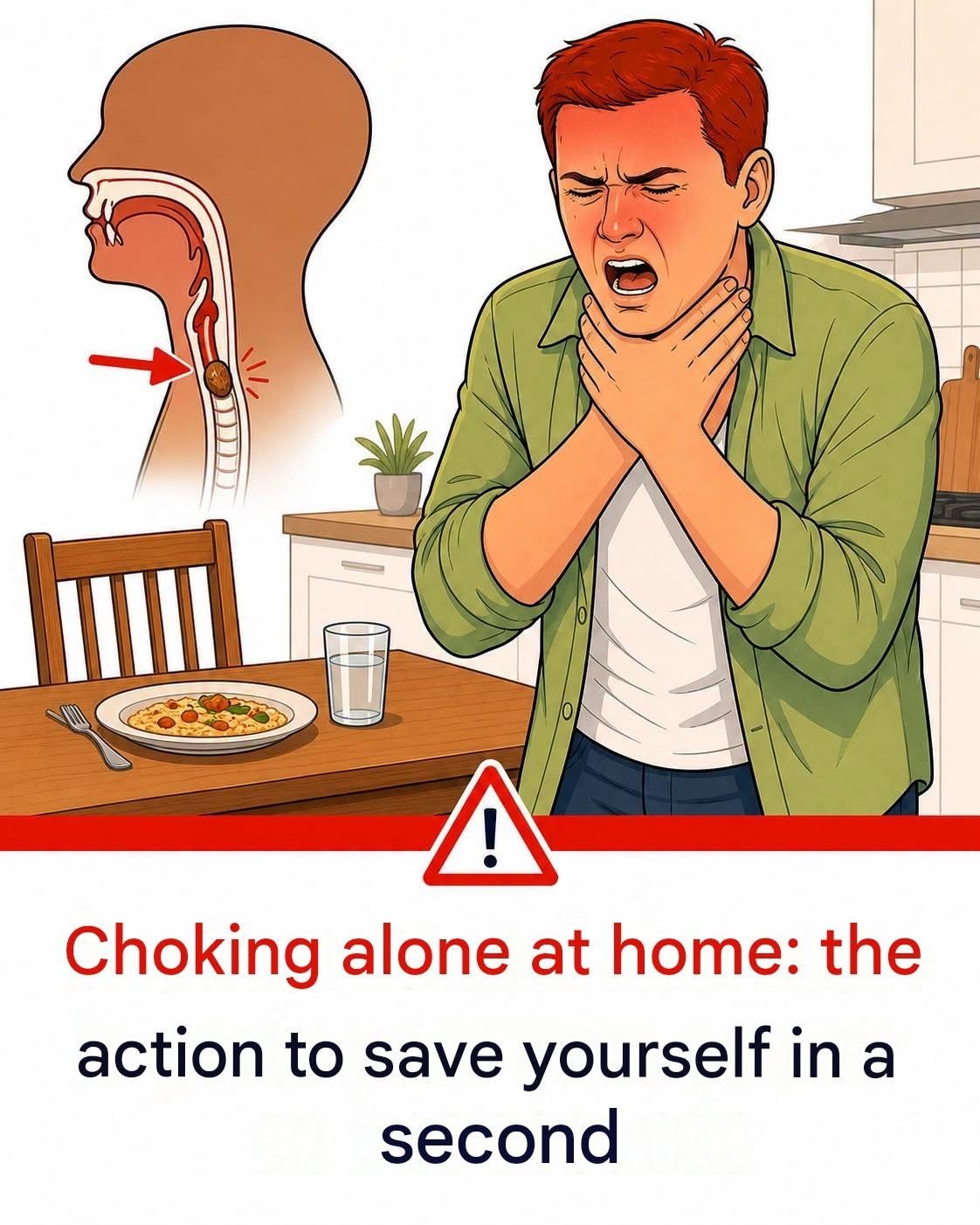
🚨 A Piece of Food Is Stuck and There’s No One Around… What to Do If You’re Choking Alone
Choking can become life-threatening within minutes because a blocked airway can prevent oxygen from reaching the brain and other vital organs. If you’re truly unable to breathe, speak, cough effectively, or make a normal sound, treat it as an emergency.
The good news is that if you’re alone, there are actions you can take immediately while getting emergency help.
1. 📞 Call Emergency Services First
If you can still make a sound or use your phone, call your local emergency number immediately.
Put the phone on speaker if possible so you can continue trying to clear the blockage.
If you cannot speak, use your phone’s emergency features if available, or make every effort to alert nearby people.
Do not spend valuable time searching online for instructions once you are severely choking.
2. 😮 If You Can Cough Forcefully, Keep Coughing
If you’re able to breathe and cough strongly, keep coughing.
A strong cough can sometimes clear the object naturally.
Don’t try to suppress the cough, and don’t immediately start drinking water in an attempt to “push the food down.”
3. 🚨 If You Cannot Breathe, Speak, or Cough Effectively
This is a severe airway obstruction.
If you’re alone, you can perform self-abdominal thrusts.
Make a fist with one hand and place it against your abdomen just above your navel and well below your breastbone.
Grasp your fist with your other hand and deliver quick, forceful inward-and-upward thrusts.
Repeat until the object comes out or you become unable to continue.
4. 🪑 Use the Edge of a Firm Object if Necessary
If you cannot generate enough force with your hands, another technique for a choking adult who is alone is to use a firm, non-sharp surface, such as the edge of a sturdy countertop or the back of a heavy chair.
Position the upper abdomen against the edge—above the navel and below the breastbone—and drive your body forcefully against the edge.
The goal is to create the same type of inward-and-upward pressure as an abdominal thrust.
Be careful not to use a sharp corner or an unstable object that could cause another injury.
5. 👊 Don’t Put Your Fingers Down Your Throat
One of the most common mistakes is trying to blindly reach into the mouth.
Don’t do this.
You can push the object farther into the airway.
Only remove an object if you can clearly see it and can easily grasp it.
6. 💧 Don’t Try to Wash the Food Down
If something is completely blocking your airway, drinking water won’t solve the problem.
Trying to swallow repeatedly can waste precious time.
Focus on clearing the airway and getting emergency assistance.
7. 🫁 If You Become Unconscious
If severe choking causes you to lose consciousness, you cannot perform self-rescue.
This is whycalling emergency services immediately is so important.
If another person arrives and you become unresponsive, they should begin appropriate choking/CPR procedures and follow instructions from emergency dispatch.
8. 🤰 What About Pregnancy or Significant Abdominal Size?
Abdominal thrusts may not be appropriate for someone who is pregnant or cannot be reached effectively around the abdomen.
In these situations,chest thrusts are used instead.
If you’re alone and pregnant, contact emergency services immediately and follow the instructions provided by the dispatcher.
9. 👶 What About Children?
The technique depends on the child’s age and whether the child is responsive.
Don’t use adult self-choking techniques on infants.
Infants and young children require age-appropriate choking procedures, and emergency medical assistance should be contacted immediately for a serious airway obstruction.
⚠️ Don’t Confuse Choking With a Partial Obstruction
Someone who is choking but can still cough forcefully, breathe, or speak may still have some airflow.
Encourage them to keep coughing and watch closely.
If they become unable to cough, speak, or breathe effectively, the situation has become a severe airway obstruction and requires immediate intervention.
🩺 Even After the Food Comes Out
Getting the food out doesn’t always mean everything is fine.
A person may have:
- Injured their throat or abdomen
- Aspirated food into the lungs
- Developed breathing difficulties
- Persistent coughing or wheezing
- Chest discomfort
If the choking episode was severe, or symptoms continue afterward, medical evaluation is appropriate.
🚨 Important Safety Reminder
If you are currently choking and cannot breathe or speak, stop reading and call your local emergency services now. If you can cough forcefully, keep coughing. If you cannot cough, breathe, or speak effectively and you’re alone, use self-abdominal thrusts or a firm surface as described above while emergency help is being summoned.
🌟 The Bottom Line
When you’re choking alone, the priorities are simple:
Get emergency help → keep coughing if you can → if you cannot breathe, speak, or cough effectively, perform self-abdominal thrusts → if necessary, use a firm surface to generate thrusts → don’t blindly put your fingers into your throat.
Knowing this procedure beforehand can make a critical difference—but formal first-aid/CPR training is the best way to learn choking rescue techniques safely and correctly.