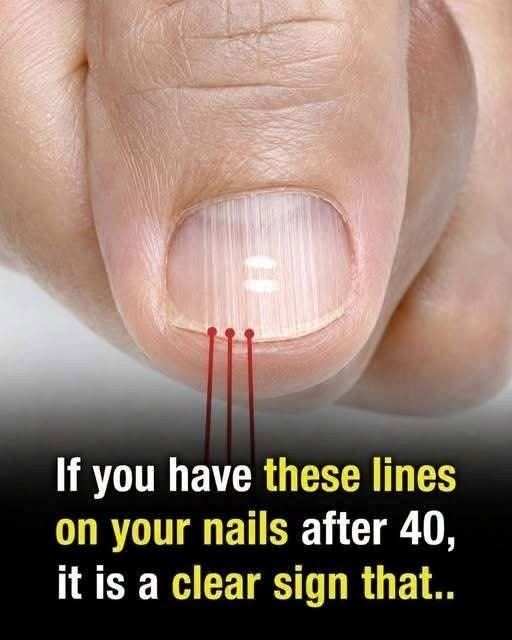
💅 If You Have These Lines on Your Nails After 40, It Could Be a Sign of…
Nail lines and ridges become more common with age, and most are not a sign of a serious disease. After 40, changes in nail growth, dryness, minor injuries, and repeated exposure to water or chemicals can all make ridges more noticeable.
However, some nail changes deserve medical attention—especially when they are new, persistent, or affecting only one nail.
1. Vertical ridges running from the cuticle to the tip
These are called longitudinal ridges. They’re extremely common and can become more prominent with aging.
If your nails otherwise look healthy and the ridges have developed gradually, they are usually not something to worry about.
2. Horizontal grooves across the nail
Deep horizontal grooves are known as Beau’s lines.
Unlike ordinary vertical ridges, these can occur when nail growth is temporarily interrupted. Possible causes include a significant illness, high fever, severe physical stress, injury to the nail, or certain medical treatments.
Because the nail grows slowly, the groove may appear weeks after the event that caused it.
3. A dark line under one nail ⚠️
A new brown or black vertical band under a nail should not automatically be blamed on aging.
Sometimes pigmentation is harmless, but a persistent dark streak—particularly one that becomes wider, changes appearance, or extends onto the surrounding skin—should be examined by a dermatologist.
Rarely, a dark streak can be a sign of melanoma of the nail unit, so it’s important not to ignore a suspicious new change.
4. White lines or spots
Small white marks are common and are often caused by minor trauma to the nail.
They do not automatically mean you have a calcium deficiency.
If extensive white discoloration affects many nails or keeps returning, a healthcare professional can determine whether further evaluation is appropriate.
5. Nails that become unusually brittle
Dry, splitting, or brittle nails can result from frequent hand washing, detergents, nail treatments, aging, or environmental exposure.
Sometimes, however, brittle nails occur alongside nutritional deficiencies or thyroid and other medical conditions.
6. A groove accompanied by changes in nail color
A ridge or groove combined with yellowing, bluish discoloration, significant thickening, or separation from the nail bed deserves more attention than a simple age-related ridge.
The combination of symptoms can help a healthcare professional determine the likely cause.
🧴 How to Keep Aging Nails Healthy
You can protect your nails by:
- Keeping them trimmed at a comfortable length.
- Moisturizing the nails and surrounding skin regularly.
- Wearing gloves when using cleaning chemicals.
- Avoiding aggressive cuticle cutting.
- Avoiding repeated trauma to the nail.
- Maintaining a balanced diet with adequate protein and essential nutrients.
Don’t start high-dose vitamins simply because you notice nail ridges. Supplements are most useful when a deficiency has actually been identified or your healthcare professional recommends them.
🚨 When Should You See a Doctor?
Make an appointment if you notice:
- A new dark streak under one nail
- A dark streak that is widening or changing
- Pigment spreading onto the skin around the nail
- A nail that suddenly changes shape or separates from the nail bed
- Persistent horizontal grooves across several nails
- Significant pain, swelling, bleeding, or an unexplained nail lesion
- Multiple nail changes occurring together with other unexplained symptoms
❤️ The Bottom Line
Nail lines after 40 are usually not a “clear sign” of one particular disease. Vertical ridges are often a normal part of aging, while horizontal grooves or unusual pigmentation may warrant closer attention.
Your nails can provide useful clues, but they cannot diagnose a disease on their own. If a nail change is new, unusual, persistent, or rapidly changing, having it examined is the safest approach.