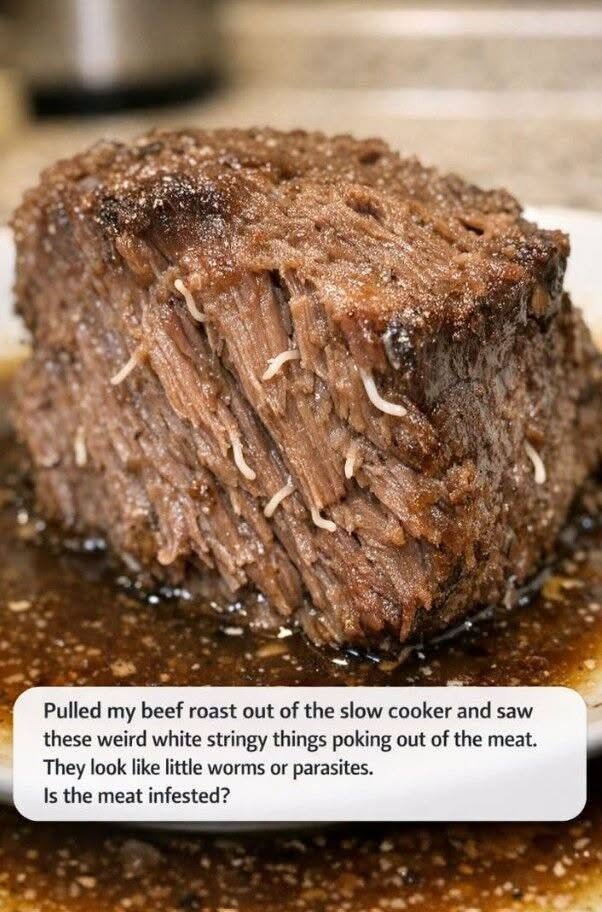
I Pulled My Beef Roast Out of the Slow Cooker and Saw Weird White Stringy Things — What Are They?
Finding white, stringy, or thread-like material on a cooked beef roast can definitely look alarming. In most cases, though, it isn’t anything dangerous or unusual.
The key is what the material looks like, where it is located, and whether it moves.
1. Most Likely: Connective Tissue
The most common explanation is simply connective tissue.
Beef contains collagen, elastin, and other connective tissues that hold muscle fibers together. During slow cooking, collagen gradually breaks down into gelatin.
You may see some of this tissue as:
- White or translucent strands
- Stringy pieces between muscle fibers
- Tough-looking membranes
- Soft, slippery pieces after cooking
These can become especially noticeable when a roast has been cooked long enough for the meat to become tender and fall apart.
This is normal and not a sign of worms.
2. It Could Be a Tendon or Silver Skin
Some cuts of beef contain tough bands of connective tissue commonly called silver skin or tendon.
Before cooking, these tissues can be firm and white. After several hours in a slow cooker, they may become softer, gelatinous, or stringy.
They aren’t harmful to eat, although particularly tough pieces may be unpleasant to chew.
3. Could It Be Fat?
Sometimes rendered beef fat can appear white, pale, or stringy, particularly as it cools.
Fat tends to be softer and more opaque than connective tissue and may form irregular blobs or ribbons rather than perfectly thin strands.
If the material melts readily when warmed, fat is a likely explanation.
4. What About Parasites or Worms?
This is the part that understandably worries people.
A genuine parasite would generally have a different appearance from ordinary connective tissue. White strands in cooked beef are much more commonly connective tissue, fat, or tendon than parasites.
Also, thorough cooking substantially reduces the risk from many foodborne parasites.
If what you saw was a stationary white strand firmly attached to the meat, especially if it was intertwined with the muscle, connective tissue is a much more likely explanation.
5. What If the Strings Were Moving?
That’s different.
If you actually observed something moving independently, don’t eat the meat until you’ve identified what it is.
Take a clear photograph and, if possible, keep the suspected material and some of the food refrigerated in a sealed container. A food-safety professional, veterinarian, or public-health authority may be able to identify it.
Don’t rely solely on appearance from a blurry photo to determine whether something is a parasite.
6. Does Slow Cooking Make Beef Safe?
Slow cooking can make beef safe if the meat reaches an appropriate internal temperature.
The important factor isn’t simply how many hours the roast spent in the slow cooker. The internal temperature of the meat matters.
For whole cuts of beef, food-safety guidance generally recommends using a food thermometer to verify that the meat has reached a safe temperature.
7. When Should You Throw the Roast Away?
Discard the meat if you notice signs that suggest spoilage or contamination, such as:
- A strong rotten or putrid odor
- Unusual sliminess unrelated to normal cooking juices
- Green, black, or unusual mold growth
- Packaging that was damaged or leaking
- Meat that was improperly refrigerated before cooking
- An unidentified object that genuinely appears to be a living organism
When in doubt about food safety, don’t taste the questionable food to test it.
The Bottom Line
If you pulled apart a slow-cooked beef roast and found white, stringy material embedded between the muscle fibers, the most likely explanation is connective tissue, tendon, silver skin, or rendered fat.
It can look surprisingly strange after hours of cooking because the meat’s structure changes as collagen breaks down.
If you want, send me a photo of the white stringy material, and I can help you identify what it most likely is.