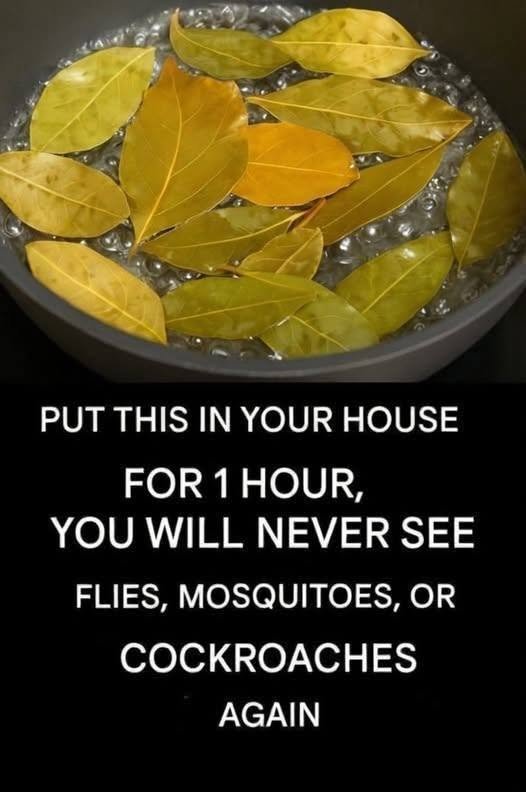
SAY GOODBYE TO FLIES, MOSQUITOES AND COCKROACHES BY BOILING THESE LEAVES
Flies, mosquitoes, and cockroaches can quickly become a nuisance around the home, particularly during warm weather. This has led to many traditional household methods involving strongly scented leaves and herbs.
Boiling aromatic leaves releases their natural volatile compounds into the air and water. Some of these scents may be unpleasant to certain insects and can potentially provide temporary deterrence.
However, it is important to understand that a homemade boiled-leaf mixture should not be considered a guaranteed insect killer. Its effectiveness can vary depending on the insect species, concentration, ventilation, and conditions in the home.
1. Bay Leaves
Bay leaves are commonly used in traditional household pest-control practices because of their strong aroma.
Their natural aromatic compounds may be unpleasant to some insects.
You can simmer a small amount of bay leaves in water and allow the aroma to circulate through the kitchen or another area where insects are a problem.
The resulting liquid can also be allowed to cool before being used for general household cleaning, provided it is used on a surface that is compatible with the solution.
The scent will not necessarily eliminate an established infestation, so sanitation and prevention remain important.
2. Mint Leaves
Mint has a strong, recognizable aroma and is another popular plant for natural insect-deterrence methods.
Fresh mint leaves can be gently simmered in water to release their aromatic compounds.
The resulting scent may help make certain areas less attractive to some insects for a limited period.
Because the aroma fades, this type of method generally requires repetition and should be combined with other pest-control measures.
3. Eucalyptus Leaves
Eucalyptus has a particularly strong fragrance due to its naturally occurring aromatic oils.
A small quantity of eucalyptus leaves can be simmered in water to release some of their scent.
However, natural does not automatically mean harmless. Concentrated eucalyptus products can be hazardous if swallowed and may cause problems for children or pets.
Keep preparations away from children and animals, and avoid placing concentrated essential oils directly on skin or food-preparation surfaces unless the product is specifically intended for that purpose.
4. The Most Important Step: Remove What Attracts Insects
A scented solution may temporarily discourage insects, but it cannot compensate for food, water, or shelter that continues to attract them.
For flies, keep food covered, clean spills promptly, and empty garbage regularly.
For cockroaches, eliminate food crumbs and grease, repair leaks, and reduce clutter that provides hiding places.
For mosquitoes, eliminate standing water around the home because mosquitoes can breed in surprisingly small amounts of stagnant water.
5. Keep the Kitchen Dry and Clean
Many household pests thrive where food and moisture are readily available.
Wipe countertops regularly and clean food residue from cooking areas.
Pay particular attention to spaces beneath appliances and around sinks, where crumbs, grease, and moisture can accumulate.
Keeping food in sealed containers can also reduce opportunities for pests to access it.
6. Don’t Rely on Scent Alone
One of the biggest limitations of natural pest-deterrent recipes is that insects may simply move to another location.
A strong smell doesn’t necessarily eliminate eggs, nests, breeding sites, or established colonies.
If cockroaches are repeatedly appearing, for example, the underlying infestation needs to be addressed rather than simply masking the smell with herbs.
Similarly, mosquitoes require control of breeding areas and protection from bites rather than relying exclusively on household fragrances.
7. Be Careful With Homemade Sprays
Never assume that a boiled plant mixture is automatically safe for every surface, person, or animal.
Some plants can irritate the skin or cause allergic reactions. Concentrated plant oils can be especially hazardous to pets.
Don’t spray unknown plant preparations onto food, dishes, children’s toys, pet bedding, or surfaces that come into direct contact with food.
When using any commercial pest-control product, follow the label instructions carefully.
A Better Natural Pest-Control Strategy
The most effective household approach is usually a combination of prevention and targeted control.
Keep food sealed, remove garbage regularly, clean spills quickly, repair leaks, reduce standing water, and seal cracks or gaps where insects can enter.
For persistent infestations, professional pest control may be more effective than repeatedly using homemade remedies.
What About Mosquitoes?
Mosquito prevention deserves particular attention because mosquitoes can transmit diseases.
Use window and door screens where possible, wear appropriate clothing, and use an insect repellent that is approved for use against mosquitoes.
Most importantly, regularly check around the home for containers or areas holding standing water.
What About Cockroaches?
Cockroaches can be particularly difficult to control once an infestation becomes established.
Good sanitation helps, but established infestations may require targeted traps, baits, or professional treatment.
Avoid indiscriminately mixing household chemicals or insecticides. Combining products can create dangerous fumes or other hazards.
What About Flies?
Flies are strongly attracted to food waste and organic material.
Keeping garbage contained, cleaning food-preparation surfaces, covering food, and maintaining clean drains can help reduce the conditions that attract them.
If flies persist despite good sanitation, identifying the source is more useful than simply trying to cover the area with a strong scent.
Final Thoughts
Boiling aromatic leaves such as bay leaves, mint, or eucalyptus can create strong scents that may temporarily discourage some insects.
But there is no reliable evidence that simply boiling leaves will make flies, mosquitoes, and cockroaches disappear permanently.
The most effective strategy is to combine any mild household deterrent with good sanitation, elimination of standing water, proper food storage, sealing of entry points, and appropriate pest-control methods when necessary.
A pleasant-smelling kitchen is nice—but removing the food, water, and shelter that pests depend on is what really makes a difference.