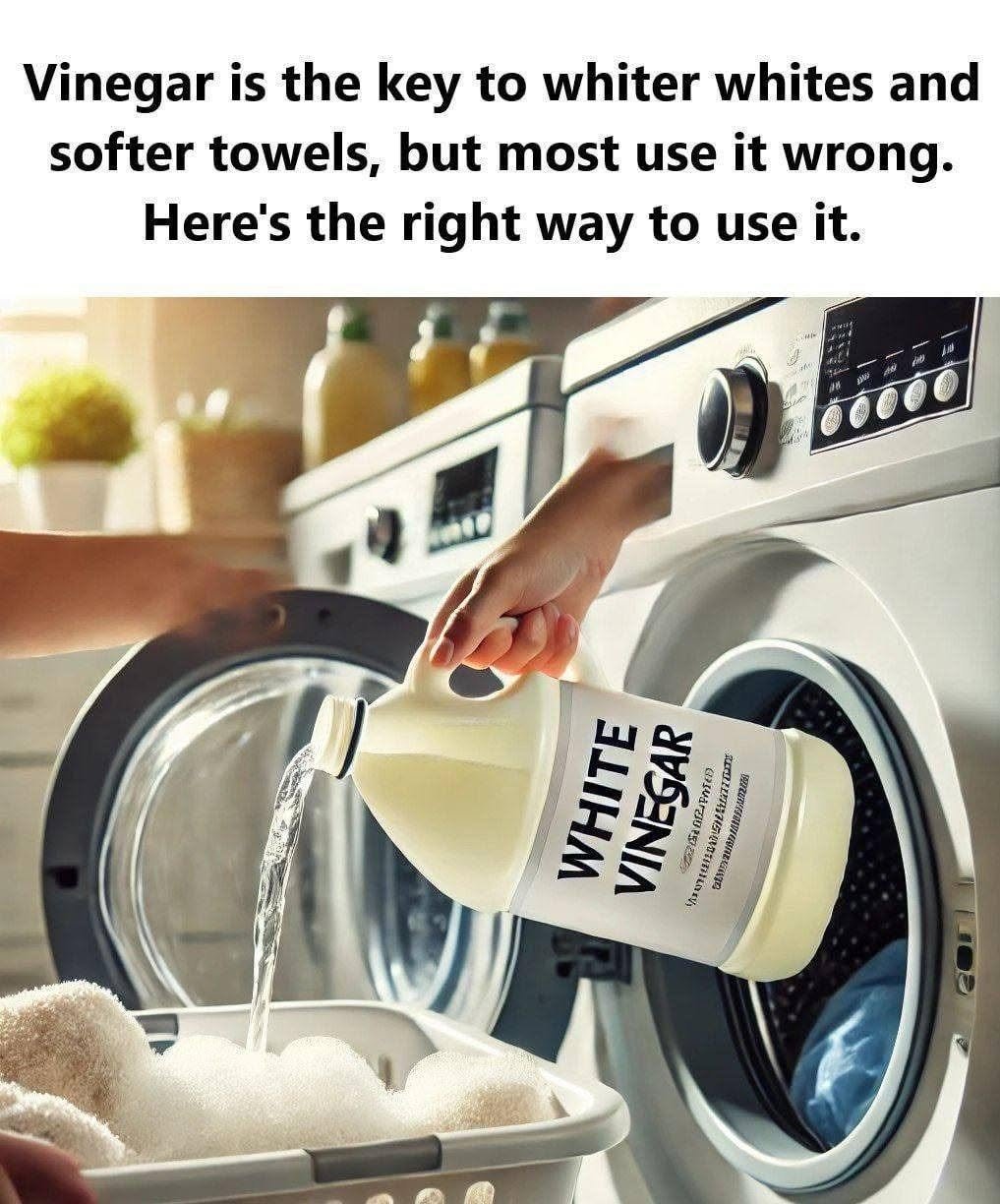
Vinegar: The Key to Whiter Whites and Softer Towels — But Most People Use It Wrong
If your towels feel stiff, your clothes look dull, or your washing machine has started to develop an unpleasant smell, you may have heard that white vinegar can help.
There is some truth to that—but vinegar isn’t a miracle laundry detergent, and using too much or using it incorrectly can cause problems.
Here’s how to use it properly.
1. Use plain white distilled vinegar
For laundry, use ordinary white distilled vinegar, not flavored, balsamic, or cleaning products containing additional chemicals.
White vinegar contains acetic acid, which can help dissolve certain mineral deposits and residues left behind by detergent and hard water.
That’s one reason it can make towels feel less stiff.
2. Put vinegar in the fabric-softener compartment
One of the easiest ways to use vinegar is to add a modest amount to the washing machine’s fabric-softener dispenser.
The machine will release it during the appropriate part of the wash cycle.
You generally don’t need to pour a large quantity directly over your clothes.
A practical starting point is about ½ cup (120 mL) for a full load, although you should check your washing machine and clothing-care instructions first.
For a smaller load, considerably less may be sufficient.
3. Vinegar can help remove detergent residue
If towels feel rough or clothes seem coated after washing, accumulated detergent and mineral residue may be contributing.
Vinegar’s acidity can help loosen some of that buildup.
This may make fabrics feel cleaner and less stiff, particularly in areas with hard water.
But vinegar doesn’t replace detergent. It isn’t designed to remove heavy grease, body oils, or all types of stains.
4. What about “whiter whites”?
This claim needs a little clarification.
Vinegar can help remove some residues that make fabrics appear dull, but it isn’t a powerful bleach and shouldn’t be considered a substitute for oxygen bleach or chlorine bleach.
If your white clothes are heavily stained or yellowed, proper washing, stain treatment, and an appropriate laundry whitener may be much more effective.
Vinegar is better thought of as a residue- and odor-management aid than a true whitening agent.
5. It can help freshen towels
Towels can develop a musty smell when detergent residue, body oils, moisture, and poor drying conditions accumulate.
Using vinegar occasionally during washing may help with some of the residue and odors.
However, the most important towel habit is drying them completely after every wash.
Don’t leave wet towels sitting in a washing machine for hours.
6. Don’t use vinegar and chlorine bleach together
This is extremely important.
Never mix vinegar with chlorine bleach.
Combining an acid such as vinegar with chlorine bleach can produce toxic chlorine gas, which can cause serious respiratory and eye irritation.
If you’ve used bleach in a load, don’t add vinegar to the same wash.
The same principle applies to other household cleaning chemicals: don’t mix products unless the manufacturer specifically says the combination is safe.
7. Don’t assume more vinegar means cleaner clothes
Pouring an entire bottle of vinegar into your washing machine isn’t going to produce dramatically better results.
More isn’t necessarily better.
Excessive acidity over repeated use may also be undesirable for some machine components, seals, or fabrics.
Use a moderate amount and follow your appliance manufacturer’s recommendations.
8. Be careful with delicate fabrics
Always read the garment’s care label.
Some delicate or specialty materials may have specific cleaning requirements, and vinegar isn’t automatically appropriate for every fabric.
When in doubt, follow the manufacturer’s care instructions.
9. Vinegar isn’t the best solution for every washing-machine problem
If your washing machine smells bad, vinegar alone may not fix the underlying issue.
The odor may be caused by:
- Mold or mildew
- Detergent buildup
- A dirty door seal
- Standing water
- A clogged filter
- Poor ventilation
Clean the machine according to its manufacturer’s instructions and leave the door or lid open between washes when appropriate so the interior can dry.
10. Don’t use vinegar as a substitute for detergent
This is perhaps the biggest misconception.
Vinegar can be useful as an occasional laundry additive, but it doesn’t contain the surfactants and other ingredients needed to properly clean heavily soiled clothing.
For everyday laundry:
Detergent = cleaning
Vinegar = optional residue/odor aid
They serve different purposes.
A Simple Laundry Routine
For ordinary towels and washable clothing:
- Sort your laundry according to the care labels.
- Use the recommended amount of laundry detergent.
- Avoid overloading the machine.
- Add a modest amount of white distilled vinegar to the fabric-softener compartment if appropriate for your machine.
- Wash using the recommended temperature and cycle.
- Remove laundry promptly.
- Dry towels completely before storing them.
One more important point
If your main goal is soft towels, don’t use excessive detergent or overload the washer. Both can contribute to poor rinsing and residue.
And while vinegar can make fabrics feel less stiff, it doesn’t create the same coating effect as conventional fabric softeners—which can actually reduce the absorbency of towels.
The Bottom Line
White distilled vinegar can be a useful laundry helper, particularly for reducing certain residues and musty odors, but it isn’t a magic whitening agent or replacement for detergent.
Use it moderately, put it in the appropriate dispenser, follow good laundry routine rather than a cure-all for every washing your appliance and garment-care instructions, and—most importantly—never mix vinegar with chlorine bleach.
Used correctly, vinegar can be a simple addition to a good laundry routine rather than a cure-all for every washing problem.