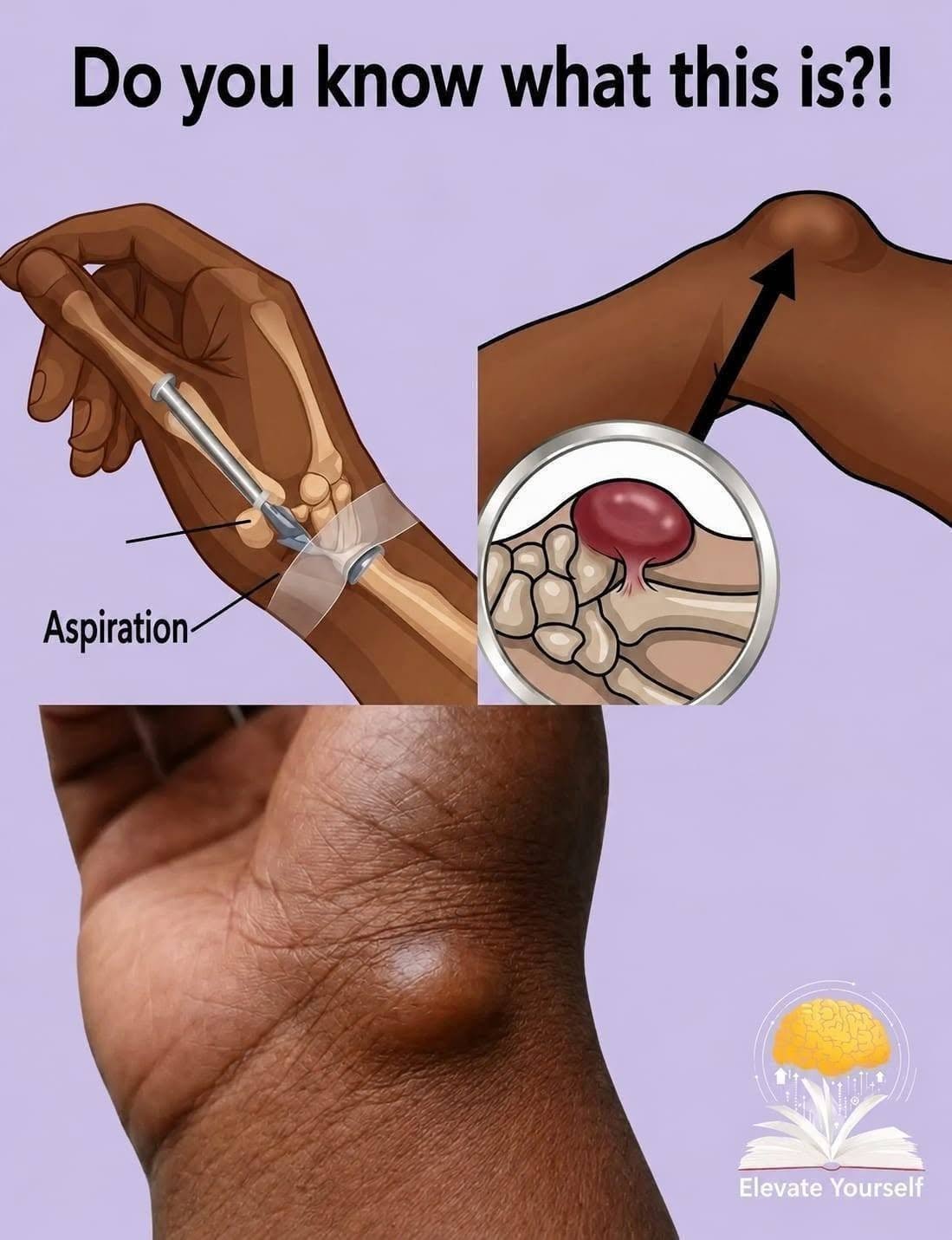
5 Things You Should Know Before Touching a Lump on Your Wrist
Finding a lump on your wrist can be worrying. The good news is that many wrist lumps are benign (non-cancerous) and some may even disappear on their own. One of the most common causes is a ganglion cyst, a small sac filled with joint or tendon fluid.
However, you shouldn’t automatically assume every wrist lump is a ganglion cyst. The location, consistency, growth, pain, and associated symptoms all matter.
1. Don’t squeeze, hit, or puncture the lump
This is the first and most important rule.
You may be tempted to press hard on the lump, massage it aggressively, hit it with an object, or puncture it with a needle to make it disappear. Don’t do this at home.
A wrist contains many important structures in a relatively small area, including:
- Tendons
- Nerves
- Blood vessels
- Joints
- Ligaments
- Small, attempting to rupture it doesn’t necessarily solve the underlying problem. The cyst can refill because its connection to bones
Trying to burst a lump can damage one of these structures. Puncturing it can also introduce bacteria and cause an infection.
Even if the lump really is a ganglion cyst, attempting to rupture it doesn’t necessarily solve the underlying problem. The cyst can refill because its connection to a joint or tendon sheath may remain.
Safer approach: Leave it alone until you know what it is. If it is causing discomfort or interfering with movement, have it assessed by a healthcare professional.
2. A ganglion cyst is one of the most common explanations
Aganglion cyst is a fluid-filled swelling that commonly develops around the wrist or hand.
It may feel:
- Smooth
- Round or oval
- Firm or slightly rubbery
- Soft in some cases
- Larger or smaller at different times
Some people notice that the lump becomes more prominent when they move the wrist or perform activities involving repetitive wrist use.
A ganglion cyst may be completely painless. Others can cause:
- Aching
- Pressure
- Discomfort when moving the wrist
- Pain after repetitive activity
- Tingling or numbness if it presses on a nearby nerve
- Reduced wrist movement in some cases
Importantly, the absence of pain doesn’t necessarily mean the lump should be ignored, particularly if it is new, persistent, or changing.
Some ganglion cysts eventually become smaller or disappear without treatment. Others remain for months or longer.
3.A previous injury can lead Not every wrist lump is a ganglion cyst
This is why physically manipulating the lump before getting a diagnosis isn’t a good idea.
Depending on its location and characteristics, a wrist lump could potentially be related to:
Lipoma
A lipoma is a benign growth of fatty tissue. It is often soft and relatively mobile under the skin.
Tendon-related swelling
Inflammation or other problems involving the tendons can sometimes produce localized swelling around the wrist.
Arthritis or joint changes
Changes involving the wrist joints can sometimes produce bumps or swelling, particularly in people with arthritis.
Bone-related prominence
Sometimes what appears to be a new lump is actually a bony prominence or a change involving one of the wrist bones.
Trauma
A previous injury can lead to swelling or other structural changes that feel like a lump.
Infection
An infected area may become increasingly painful, warm, red, or swollen and may sometimes produce pus or drainage.
Other growths
Most wrist lumps are not cancerous, but persistent, rapidly enlarging, unusually hard, or fixed masses deserve medical evaluation rather than self-treatment.
The key point is: you can’t reliably identify a lump simply by squeezing it.
4. Location provides important clues
Where the lump appears can help a clinician narrow down the possibilities.
Lump on the back of the wrist
Ganglion cysts are particularly common around the back (dorsal side) of the wrist.
You might notice the lump more clearly when bending the wrist.
Lump on the palm side
Ganglion cysts can also occur on the palm side (volar side), but this area contains important blood vesselsProblems involving the small and nerves.
That’s another reason not to puncture or aggressively manipulate a lump yourself.
Lump near the base of the thumb
A lump near the thumb side can sometimes be associated with a joint, tendon, or ganglion cyst.
Lump near the little-finger side
Problems involving the small wrist joints, tendons, or other structures can produce swelling in this area.
Location alone isn’t enough for a diagnosis, but it provides useful information when combined with symptoms.
5. Know the warning signs
Most wrist lumps aren’t emergencies, but certain features deserve prompt medical attention.
Seek medical attention if:
- The lump is rapidly increasing in size.
- It becomes increasingly painful.
- The skin becomes red or hot.
- You develop fever or feel unwell.
- There is pus or other drainage.
- You experience numbness or tingling in the hand or fingers.
- Your grip becomes weaker.
- You have difficulty moving the wrist or fingers.
- The lump feels unusually hard or fixed.
- It appeared after a significant injury.
- The swelling keeps returning.
- The lump persists and you don’t know what it is.
Seek urgent care for severe symptoms
Get prompt medical attention if a wrist lump is accompanied by severe pain, significant swelling after trauma, loss of sensation, marked weakness, or a hand that becomes unusually pale, blue, or cold.
These symptoms can indicate a problem involving nerves or blood circulation and shouldn’t be treated at home.
What happens if you leave a suspected ganglion cyst alone?
If a clinician determines that the lump is a ganglion cyst and it isn’t causing significant problems, observation may be all that’s necessary.
Some cysts shrink or disappear spontaneously.
If it isn’t painful and isn’t interfering with your activities, treatment may not be necessary.
However, monitor it for changes in:
- Size
- Pain
- Skin color
- Temperature
- Mobility
- Wrist movement
- Sensation in the hand
Taking an occasional photograph can also help you notice whether its size is changing over time.
How is a wrist lump diagnosed?
A healthcare professional will generally start with a physical examination.
They may ask:
- When did you first notice it?
- Has it grown?
- Does it hurt?
- Does the size change?
- Does movement make it worse?
- Have you injured the wrist?
- Do you have numbness or tingling?
- Does it affect your grip?
- Have you had a similar lump before?
They may examine how the lump moves and how your wrist and fingers function.
Imaging
Depending on what the examination suggests, the clinician may recommend imaging.
Ultrasound can be particularly useful for determining whether a lump is fluid-filled or solid and for examining nearby soft tissues.
X-rays can help evaluate bones and joint abnormalities, although a simple ganglion cyst may not be visible on an ordinary X-ray.
MRI may sometimes be used when the diagnosis isn’t clear or when more detailed evaluation of the wrist’s soft tissues is needed.
What treatments are available?
Treatment depends on the diagnosis and how much trouble the lump is causing.
1. Observation
For a painless, uncomplicated ganglion cyst, simply monitoring it may be appropriate.
2. Activity modification
If certain repetitive movements make the lump painful, temporarily reducing those activities may help.
For example, if prolonged wrist bending or repetitive gripping aggravates symptoms, reducing those activities can decrease irritation.
3. Pain relief
If appropriate for you, a healthcare professional or pharmacist can advise you about suitable pain-relief options.
Don’t assume an over-the-counter medicine is safe if you have other medical conditions or take regular medications.
4. Aspiration
A healthcare professional may sometimes use a needle to drain a ganglion cyst.
This should not be attempted at home.
One limitation is that the cyst can return because the underlying connection to the joint or tendon sheath may remain.
5. Surgery
Surgery may occasionally be considered when a cyst repeatedly returns or causes persistent pain, nerve symptoms, or significant functional problems.
As with any procedure, there are potential risks, so the decision should be individualized.
What NOT to do
Avoid these common home remedies:
❌ Don’t hit the lump with a book or other object.
❌ Don’t try to crush it.
❌ Don’t puncture it with a needle.
❌ Don’t attempt to drain it yourself.
❌ Don’t repeatedly squeeze it to see whether it will disappear.
❌ Don’t apply irritating chemicals or unproven substances to the skin.
These approaches can cause injury or infection without addressing the underlying cause.
Can exercise make it worse?
It depends on the cause.
Gentle movement is generally useful for maintaining wrist function, but an activity that consistently causes pain or increases swelling should be reduced temporarily.
If you’re doing weightlifting, push-ups, repetitive gripping, or other activities that put substantial stress on the wrist, consider modifying the activity until the cause of the lump is established.
Don’t completely immobilize the wrist for prolonged periods without medical advice, because unnecessary immobilization can contribute to stiffness and weakness.
Is a wrist lump cancer?
It’s understandable to worry about this, but most wrist lumps are benign.
A lump being present does not mean it is cancer.
Nevertheless, a mass that is rapidly growing, unusually hard, fixed to deeper tissues, persistently painful, or otherwise unusual should be evaluated by a healthcare professional rather than assumed to be a harmless cyst.
A simple rule to remember
Don’t pop it. Don’t punch it. Don’t ignore significant changes.
If a new wrist lump appears, the safest approach is to observe it without manipulating it and arrange a medical assessment if it persists, grows, hurts, affects movement, or produces numbness or weakness.
Bottom line
A wrist lump is often something relatively harmless such as a ganglion cyst, but there are several possible causes. The safest first step is proper identification rather than trying to remove the lump yourself.
If you describe exactly where the lump is, how big it is, whether it’s hard or soft, how long you’ve had it, and whether it hurts when you move your wrist, I can walk you through the most likely possibilities and what to do next.