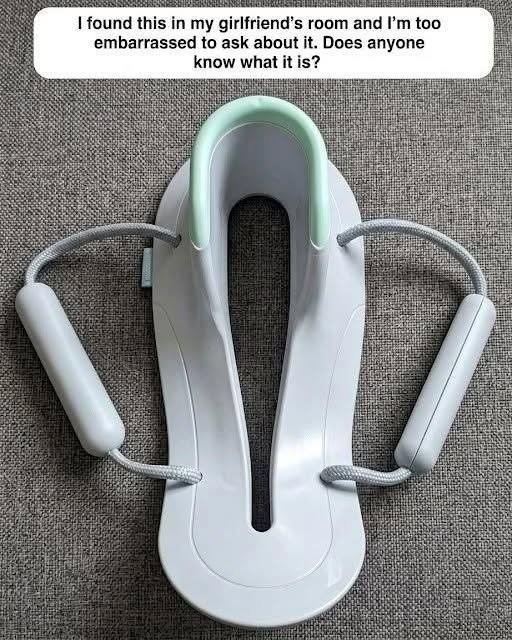
What Is This Object Found in the Room?
From the design in the photo, this appears to be a cervical traction / neck-stretching device. It is designed to support the head and apply gentle pulling or stretching around the neck area. It is sometimes marketed as a cervical decompression device, neck traction device, or neck stretcher.
The unusual shape can make it look mysterious if you’ve never seen one before, but its appearance is consistent with a type of home-use neck therapy or rehabilitation equipment.
How the Device Works
The device has several recognizable components:
1. The Large White Central Frame
The long, curved white section is the main support structure. It is shaped to accommodate the person’s head and neck while the device is being used.
The long opening in the middle helps keep the structure relatively lightweight and provides clearance around the head/neck area.
2. The Padded Side Pieces
The two white cylindrical pieces on either side appear to provide contact/support around the head or upper neck.
They’re connected to the central frame with flexible cords, allowing some adjustment of their position.
3. The Flexible Cords
The gray cords are particularly important. They allow the side supports to move or provide controlled tension.
Depending on the specific model, the tension and positioning can be adjusted to create a gentle stretching effect.
4. The Green Padded Section
The green portion at the top appears to be another padded contact/support area. Its purpose is likely to make contact with the head or neck while reducing pressure from the hard plastic frame.
What Is Cervical Traction?
Cervical traction is a technique in which the neck is gently stretched along its natural axis.
The basic idea is to create a controlled pulling force that can temporarily reduce pressure and tension around the cervical (neck) region.
Traction can be performed in different ways, including:
- Physical-therapy equipment
- Specialized traction tables
- Over-the-door systems
- Inflatable neck devices
- Mechanical traction machines
- Certain home-use neck supports
The object in your photograph appears to belong to the home-use category.
Why Would Someone Have One?
There are several completely ordinary reasons someone might own a device like this.
Neck Tension
People who spend many hours sitting at a computer or looking down at a phone sometimes experience considerable neck and shoulder tension. A person may use a neck-support device as part of a broader stretching routine.
Posture-Related Discomfort
Poor posture can contribute to discomfort around the neck and upper back. Some people use traction or stretching equipment in an attempt to improve comfort.
Physical Therapy or Rehabilitation
A person may have purchased a device after seeing a physical therapist or healthcare professional.
General Neck Care
Some people simply like using stretching or massage equipment after work, exercise, or long periods of sitting.
So finding one in someone’s bedroom doesn’t by itself indicate anything unusual or embarrassing.
Is It a Massage Device?
Not exactly.
A massage device generally uses vibration, rolling, percussion, or pressure to manipulate muscles.
This type of device is instead intended primarily for positioning, support, and/or traction/stretching.
Some products may combine multiple functions, so the exact purpose depends on the manufacturer and model.
Is It Safe?
This is where some caution is important.
A cervical traction device isn’t something everyone should automatically use. Applying too much force or positioning the neck incorrectly can potentially cause pain, dizziness, headaches, nerve symptoms, or other problems.
Someone with certain neck or spinal conditions, recent injuries, instability, neurological symptoms, or other medical issues should get appropriate professional advice before using traction.
It also shouldn’t be assumed that stronger traction is better. More pulling force isn’t necessarily more effective.
If the device causes significant pain, numbness, weakness, dizziness, or other unusual symptoms, it should be stopped and evaluated appropriately.
Can You Tell the Exact Brand From the Photo?
Not reliably.
The photograph gives enough information to make a reasonable identification of the type of object, but there isn’t a clearly visible brand name, model number, or label.
There are multiple neck-traction products with similar constructions, so I wouldn’t claim that this particular photograph proves one exact manufacturer or model.
If there is a logo, label, serial number, or writing on the back or side, that could make identification much more precise.
Why Does It Look So Strange?
That’s probably why the original caption works so well.
The object has:
- A large plastic frame
- A long central opening
- Two dangling padded pieces
- Several cords
- An unusual head-shaped design
Without knowing its purpose, it can easily look like some kind of specialized or personal device.
But once you recognize the design as neck traction equipment, the shape makes considerably more sense.
The Simple Answer
It’s most likely a cervical neck traction/neck-stretching device.
It’s intended to support and/or gently stretch the neck and may be used for relaxation, neck discomfort, posture-related tension, or rehabilitation.
And if you’re wondering whether finding it in your girlfriend’s room necessarily means something embarrassing:
No. There’s nothing inherently sexual or suspicious about the object based on its appearance. It looks like a piece of neck-care/rehabilitation equipment.
If you want to know exactly how this particular device is supposed to be worn/used, a photo of the back, underside, and any label or logo would make it much easier to identify the specific model.