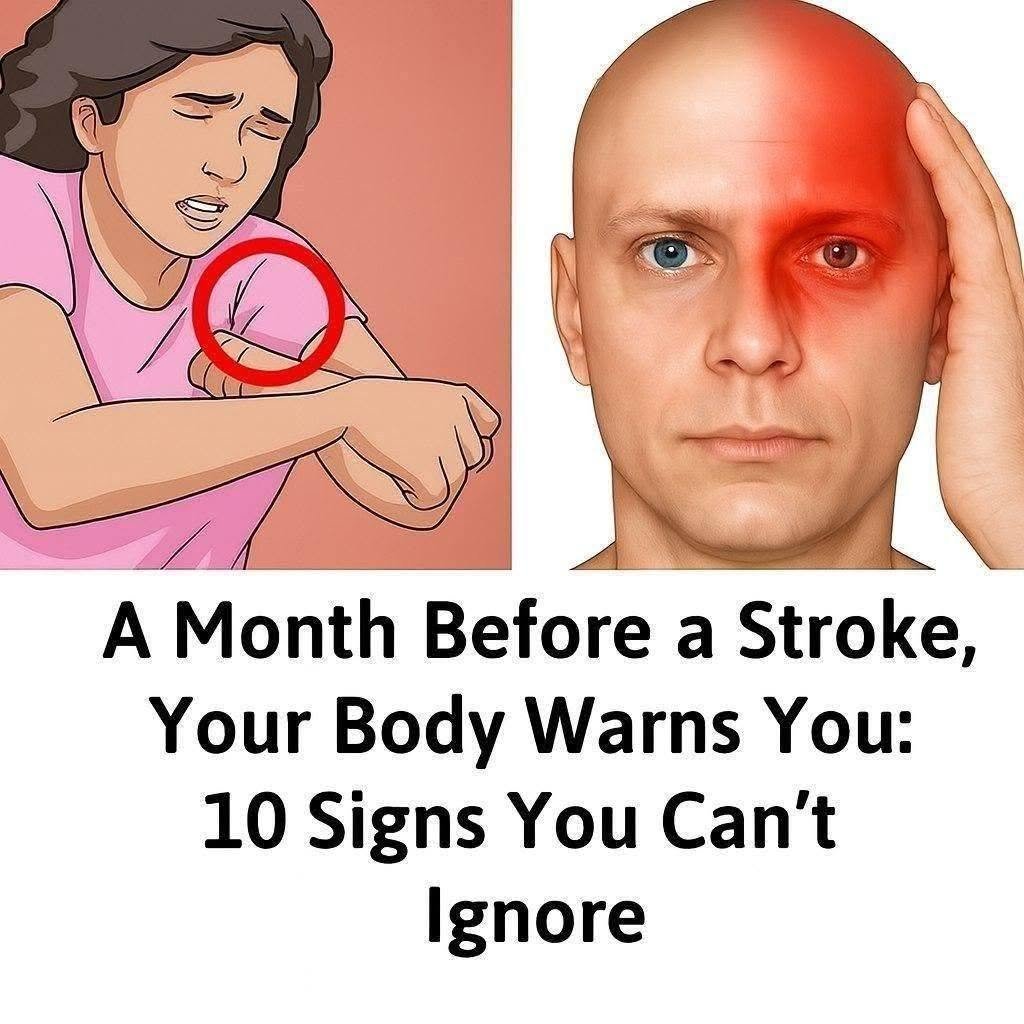
A Month Before a Stroke, Your Body Warns You? 10 Signs You Should Never Ignore
You’ve probably seen the headline: “A month before a stroke, your body warns you.”
There’s an important correction to make.
A stroke doesn’t necessarily give you a month of warning. It can occur suddenly, without obvious symptoms beforehand.
However, some people experience temporary neurological symptoms called a transient ischemic attack (TIA) before a major stroke. A TIA can produce the same kinds of symptoms as a stroke, but they resolve because the blockage is temporary.
A TIA is a medical warning—not something to ignore.
1. Sudden Weakness on One Side
Sudden weakness or numbness in the face, arm, or leg—particularly on one side of the body—is one of the most important stroke warning signs.
Someone may suddenly find that:
- One arm feels heavy
- A leg becomes weak
- One side of the face droops
- They have difficulty gripping something
Don’t wait to see whether it improves.
2. Sudden Facial Drooping
Ask the person to smile if they’re able.
If one side of the face suddenly droops or feels numb, it could be a stroke.
Facial weakness can be subtle, so don’t dismiss a new uneven smile as tiredness.
3. Sudden Trouble Speaking
A person may suddenly:
- Slur their speech
- Struggle to find words
- Say inappropriate or confusing words
- Have difficulty understanding what others are saying
A sudden change in communication can be a neurological emergency.
4. Sudden Vision Changes
Stroke or TIA can sometimes cause sudden vision problems.
These may include:
- Loss of vision in one eye
- Double vision
- Blurred vision
- Loss of part of the visual field
Sudden unexplained vision loss requires urgent medical attention—even if it disappears.
5. Sudden Loss of Balance or Coordination
Someone may suddenly become unsteady, stumble, or have difficulty coordinating their movements.
This is especially concerning when it appears alongside dizziness, weakness, vision problems, or speech changes.
Don’t assume sudden severe imbalance is simply an inner-ear problem without medical evaluation.
6. Sudden Severe Dizziness
Dizziness is extremely common and usually has causes unrelated to stroke.
But sudden, severe dizziness accompanied by difficulty walking, weakness, numbness, double vision, or speech problems can be a stroke warning sign.
That combination warrants emergency evaluation.
7. Sudden Severe Headache
A sudden, extremely severe headache that is unusual for the person can occur with bleeding in or around the brain.
It may be accompanied by:
- Vomiting
- Neck stiffness
- Confusion
- Loss of consciousness
- Weakness
- Vision changes
A sudden “worst-ever” or exceptionally severe headache should be treated as an emergency.
8. Sudden Confusion
A person may suddenly have difficulty understanding what’s happening or following a conversation.
They might appear:
- Disoriented
- Unable to find words
- Unusually confused
- Unable to follow simple instructions
Sudden confusion has many possible causes, but stroke is one of the conditions that must be ruled out urgently.
9. Sudden Difficulty Walking
A sudden change in the ability to walk normally can be a neurological warning sign.
For example, someone who normally walks independently may suddenly:
- Drag one foot
- Stumble
- Become unable to stand steadily
- Have difficulty coordinating their legs
Don’t wait for additional symptoms before seeking help.
10. A Brief Episode That Completely Goes Away
This is one of the most important signs to understand.
A person might suddenly develop weakness, numbness, speech problems, or vision loss and then appear completely normal 10 or 20 minutes later.
That does not mean the problem was harmless.
It could have been a TIA.
A TIA can be a warning that a major stroke may occur, and urgent medical assessment is needed to determine the cause and reduce future risk.
Remember FAST
You don’t have to memorize ten symptoms.
Remember:
F — Face: Is one side of the face drooping?
A — Arms: Is one arm weak or numb?
S — Speech: Is speech suddenly slurred, strange, or difficult?
T — Time: Call emergency services immediately if these symptoms appear suddenly.
Other sudden symptoms—particularly vision loss, severe dizziness, loss of balance, or an unusually severe headache—also require urgent attention.
Don’t Wait for Symptoms to Become Severe
This is where many people make a dangerous mistake.
They may think:
“It’s probably nothing. Let’s wait and see.”
Don’t.
Stroke treatments are often highly time-dependent. The sooner a person reaches an emergency department, the sooner doctors can determine whether treatments to restore blood flow or limit brain injury may be appropriate.
What If the Symptoms Disappear?
Still seek urgent medical attention.
A TIA may last only a few minutes and leave no lasting symptoms.
That doesn’t make it harmless.
A healthcare professional can investigate possible causes and assess the person’s risk of a future stroke.
What Should You Do if You Suspect a Stroke?
If sudden stroke-like symptoms occur:
- Call your local emergency services immediately.
- Note the time the symptoms began—or the last time the person was known to be normal.
- Keep the person safe while waiting for medical help.
- Don’t give food, drink, or medication unless instructed by medical professionals.
- Don’t wait for symptoms to disappear.
- Don’t attempt to treat the episode with home remedies.
The exact time symptoms started can be extremely important to doctors.
What About Symptoms That Happen Weeks Earlier?
There isn’t a reliable checklist of symptoms that means “a stroke will happen in exactly one month.”
Fatigue, headaches, dizziness, poor sleep, neck pain, or tingling can have dozens of causes and don’t by themselves predict a stroke.
The symptoms that deserve the most attention are sudden neurological changes, especially weakness, numbness, speech difficulty, facial drooping, vision loss, severe balance problems, or sudden severe headache.
Reduce Your Stroke Risk
While no strategy can eliminate stroke risk completely, several factors are modifiable.
Work with your healthcare professional to control:
- High blood pressure
- High cholesterol
- Diabetes
- Smoking and tobacco use
- Certain heart conditions, including atrial fibrillation
- Physical inactivity
- Excess alcohol consumption
Taking prescribed medication consistently and attending recommended checkups can also be important.
The Bottom Line
The idea that “your body always warns you one month before a stroke” is not medically accurate.
A stroke can occur suddenly.
But temporary stroke-like symptoms may represent a TIA, and a TIA can be an important warning that a major stroke could follow.
Don’t wait for ten signs. Don’t wait for tomorrow.
If someone suddenly develops facial drooping, one-sided weakness or numbness, speech difficulty, vision loss, severe dizziness, loss of balance, confusion, or another sudden neurological change, call emergency services immediately.
When it comes to stroke, time is brain.