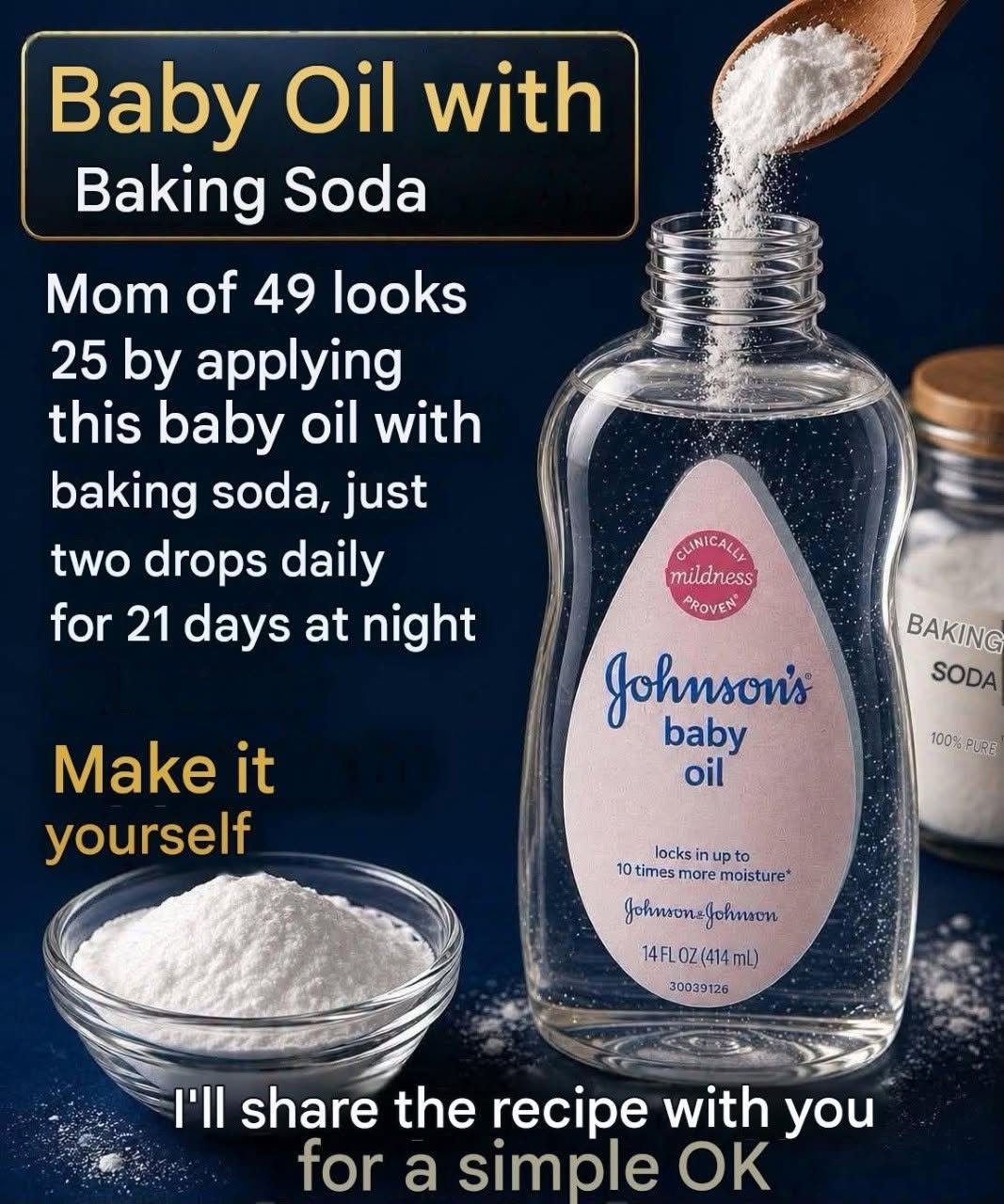
Baby Oil With This Bicarbonate Mixture: What It Can and Cannot Do
Baby oil and baking soda (sodium bicarbonate) are sometimes promoted online as a simple home remedy for smoother, brighter, or softer skin. The combination sounds harmless, but mixing two household ingredients doesn’t automatically make an effective or safe skincare treatment.
Baby oil is generally a mineral-oil-based product designed to reduce moisture loss from the skin. Baking soda, on the other hand, is alkaline and can disrupt the skin’s natural acidic environment.
Before putting this mixture on your face or body, it’s important to understand what it may actually do.
1. Baby Oil Helps Reduce Moisture Loss
Baby oil is commonly made primarily from mineral oil, sometimes with fragrance.
Mineral oil forms a layer over the skin that helps reduce water loss. That’s why it can leave skin feeling smooth and moisturized.
It doesn’t necessarily add water to dry skin, however. A moisturizer containing humectants and other skin-supporting ingredients may be more useful for genuinely dry skin.
If you use baby oil, applying a small amount to slightly damp skin can help seal in existing moisture.
2. Baking Soda Is Not a Gentle Skin Treatment
Baking soda has mild abrasive properties and is alkaline.
Your skin naturally has a mildly acidic surface known as the acid mantle, which contributes to the skin barrier and its normal microbial environment.
Applying alkaline substances repeatedly can irritate the skin and potentially interfere with the barrier.
You may initially feel that baking soda makes the skin feel exceptionally clean or smooth.
That doesn’t necessarily mean it’s improving your skin.
3. Be Especially Careful With the Face
The skin on your face can be more sensitive than the skin on areas such as your elbows or feet.
Using baking soda as a scrub may cause:
- Dryness
- Burning
- Redness
- Irritation
- Increased sensitivity
The risk can be higher if you already have eczema, rosacea, acne, or a damaged skin barrier.
For facial exfoliation, products specifically formulated for facial skin are generally a better choice.
4. Don’t Expect It to Remove Dark Spots
A common online claim is that baking soda mixed with oil can remove dark spots, pigmentation, or discoloration.
There’s no good reason to expect this mixture to safely erase pigmentation.
Aggressive scrubbing can actually irritate the skin and make post-inflammatory hyperpigmentation more noticeable, particularly in people whose skin tends to darken after irritation.
For pigmentation, sun protection is one of the most important steps.
5. It Won’t Permanently Remove Hair
Another popular claim involves using baking soda mixtures to remove or permanently weaken facial or body hair.
There is no reliable evidence that baby oil and baking soda permanently remove hair.
At most, rubbing a mixture onto the skin may temporarily affect the surface or make existing hair feel different.
It won’t destroy the hair follicle in the way an established hair-removal treatment can.
6. It Isn’t a Proven Treatment for Wrinkles
Baby oil can temporarily make dry skin look smoother because it reduces moisture loss.
That can make fine lines appear less noticeable for a short time.
But it doesn’t reverse the underlying aging process.
Baking soda doesn’t provide a proven anti-aging benefit and may actually irritate the skin when used repeatedly.
For long-term skin aging, daily sunscreen and appropriate moisturization are much more useful foundations.
7. Don’t Use It on Broken or Irritated Skin
Avoid experimenting with baking soda on skin that is:
- Cut
- Scraped
- Sunburned
- Cracked
- Inflamed
- Recently shaved
- Experiencing a rash
Damaged skin is more vulnerable to irritation.
If you’ve recently shaved, for example, adding an abrasive alkaline ingredient can make razor irritation worse.
8. Fragrance Can Also Be a Problem
Some baby oils contain fragrance.
Fragrance isn’t necessarily harmful to everyone, but it can trigger irritation or allergic reactions in sensitive individuals.
If your skin is easily irritated, choosing a fragrance-free product is often preferable.
9. If You Still Want to Try It, Patch-Test First
If you’re determined to experiment with a new skincare mixture, don’t immediately apply it over a large area.
Test a small amount on an inconspicuous area first and observe the skin.
Stop if you develop burning, itching, redness, swelling, or a rash.
However, a patch test doesn’t guarantee that repeated use will be harmless.
10. There Are Safer Ways to Get Softer Skin
If your goal is simply softer, smoother skin, you don’t need an aggressive DIY mixture.
Consider:
- A fragrance-free moisturizer
- Petroleum jelly for very dry areas
- A gentle cleanser
- Lukewarm rather than very hot showers
- Applying moisturizer shortly after bathing
- Sunscreen on exposed skin
For rough areas such as heels or elbows, a moisturizer containing ingredients such as urea, lactic acid, or salicylic acid may be more appropriate than baking soda.
What About Baby Oil Alone?
Baby oil can be useful as an occlusive moisturizer for many people.
If your skin tolerates it, a small amount applied after bathing can help reduce water loss and leave the skin feeling softer.
But keep it away from slippery floors and be cautious when applying it to the feet, because it can make surfaces dangerously slippery.
Also remember that baby oil is not sunscreen.
When Should a Skin Problem Be Checked?
Don’t keep experimenting with household mixtures if you have a persistent skin problem.
See a healthcare professional or dermatologist if you have:
- A rash that doesn’t improve
- Persistent itching
- Painful or infected-looking skin
- Rapidly changing pigmentation
- A new or changing mole
- Significant swelling
- Repeated skin reactions
A skin condition that looks like “dryness” may sometimes have another underlying cause.
The Bottom Line
Baby oil and baking soda may sound like a simple beauty hack, but there is no established medical benefit to combining them.
Baby oil can help reduce moisture loss and soften dry skin.
Baking soda is a different story: because it is alkaline and mildly abrasive, repeated use can irritate the skin and disrupt its protective barrier.
So if the goal is softer skin, baby oil alone—or, better yet, a properly formulated moisturizer—is generally a more sensible choice than scrubbing your skin with baking soda.
And if someone claims that this mixture can permanently remove hair, erase wrinkles, cure pigmentation, or transform your skin overnight, treat that claim skeptically. A simple household mixture isn’t a substitute for evidence-based skincare.