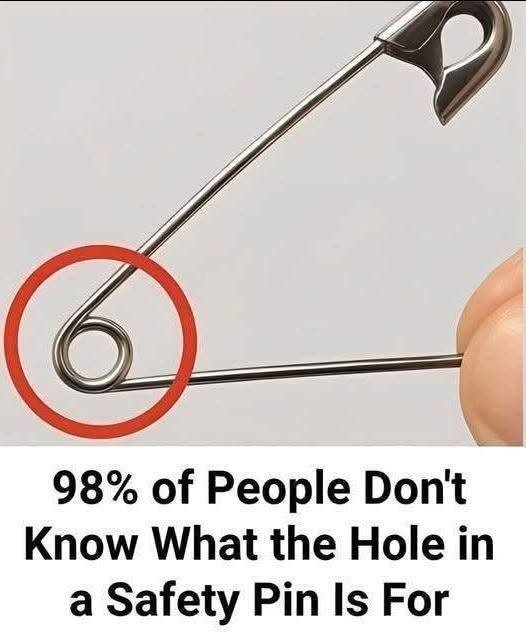
The Hidden Purpose of the Tiny Hole in a Safety Pin—and Why It’s a Brilliant Design
That tiny hole near the head of a safety pin may look like a simple manufacturing detail, but it serves an important purpose. It is part of what makes the safety pin strong, secure, and practical.
What Is the Tiny Hole For?
The small opening is essentially related to the way the wire is formed and secured at the head of the safety pin.
A traditional safety pin is made from a single length of springy metal wire. The wire is bent into a loop and then shaped into the familiar pin form. The head has to perform several jobs at once:
- Hold the sharp point safely when the pin is closed
- Provide a place for the wire to flex
- Help maintain tension in the pin
- Allow the pin to open and close repeatedly without easily breaking
The small hole or opening is therefore part of the spring-and-loop structure rather than a useless decoration.
How Does a Safety Pin Actually Work?
The brilliance of a safety pin comes from its use of spring tension.
When you open the pin, you bend the metal wire. The wire naturally wants to return to its original shape. When you release it, this stored elastic energy helps pull the pin back toward its closed position.
This gives the safety pin two important characteristics:
1. It stays closed.
The spring tension helps keep the point secured inside the protective clasp.
2. It can be reused.
The metal can flex repeatedly without permanently changing shape—provided the pin isn’t bent too far.
Why Is the Head Designed This Way?
The head isn’t simply a holder for the sharp point. It is carefully shaped to combine safety, flexibility, and strength.
When the pin is closed, the sharp point is enclosed by the head. This reduces the chance of accidentally being stuck by the exposed tip.
At the same time, the curved section acts somewhat like a spring. This is what gives the pin its characteristic snap and tension.
The Hole Also Helps With Manufacturing
The small opening is also a consequence of how the wire is coiled and shaped during manufacturing.
Instead of constructing a safety pin from several separate components, traditional designs can be produced largely from one continuous piece of wire. This makes the design relatively simple, inexpensive, and mechanically efficient.
That simplicity is one reason the safety pin has remained useful for generations.
Why Is This Considered Brilliant Engineering?
The safety pin is a wonderful example of simple mechanical engineering.
A tiny object combines several functions:
- Spring: stores and releases energy.
- Hinge-like action: allows repeated opening and closing.
- Protective clasp: covers the sharp point.
- Fastener: holds fabric together.
- Tension mechanism: helps keep the pin closed.
And it accomplishes all of this with essentially one piece of shaped wire plus the clasp/head structure.
A Little History
The modern safety pin is strongly associated with Walter Hunt, an American inventor who patented a safety-pin design in 1849.
Hunt’s design used a coiled section of wire to create spring action and incorporated a clasp to protect the sharp point. The basic principle proved remarkably durable.
More than 170 years later, the same fundamental idea is still recognizable in safety pins used for clothing, sewing, crafts, temporary repairs, and countless everyday situations.
The Bigger Lesson
The fascinating thing about the safety pin is that its usefulness doesn’t come from having complicated technology.
It comes from using the properties of the material intelligently.
The wire itself provides the spring force. The curves provide flexibility. The clasp provides safety. The shape provides mechanical advantage.
So that tiny hole and the surrounding coil are reminders that good engineering often hides in very simple objects.
In Short
The tiny opening around the head of a safety pin isn’t merely an aesthetic feature. It is associated with the coiled, spring-like construction that allows the pin to flex, return to position, and remain securely closed.
That’s the real genius of the safety pin: a remarkably small amount of material is shaped so that it performs several mechanical functions at once.