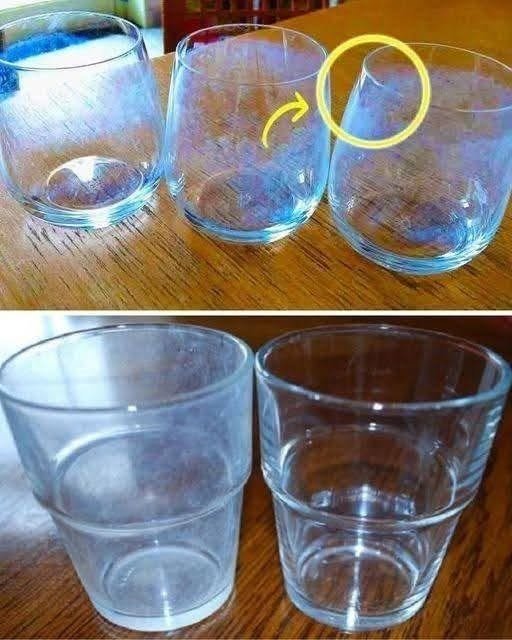
🥛 How to Remove White Patina From Glasses and Make Them Shine Again
Those cloudy white marks on drinking glasses are usually caused by hard-water mineral deposits, detergent residue, or—if the cloudiness doesn’t disappear—permanent etching of the glass.
Before throwing the glasses away, try this simple method.
🧼 1. Start With White Vinegar
White vinegar contains acetic acid, which can dissolve many mineral deposits left by hard water.
What you’ll need:
- White vinegar
- Warm water
- A soft sponge or microfiber cloth
- Dish soap
How to do it:
- Fill a bowl or sink with equal parts white vinegar and warm water.
- Soak the cloudy glasses for about 15–30 minutes.
- Gently wipe the surface with a soft sponge.
- Rinse thoroughly with clean water.
- Wash normally with a small amount of dish soap.
- Dry immediately with a clean microfiber cloth.
For stubborn mineral deposits, you can repeat the process rather than scrubbing aggressively.
✨ 2. The “Cool Trick”: Warm Vinegar Soak
For particularly stubborn white deposits, gently warming the vinegar-water solution can make the cleaning process more effective.
Don’t use boiling water on cold glass. Sudden temperature changes can cause glass to crack or shatter.
A comfortably warm solution is sufficient.
🍋 3. Don’t Mix Cleaning Chemicals
Never mix vinegar with:
- Bleach
- Chlorine-based cleaners
- Ammonia-based cleaners
Mixing household chemicals can create dangerous fumes.
🔍 4. What If the White Film Won’t Come Off?
This is important.
If you’ve removed the mineral deposits but the glass remains permanently cloudy, the glass may have suffered etching.
Etching can happen after repeated exposure to:
- Very hot dishwasher cycles
- Strong dishwasher detergents
- Soft-water conditions combined with aggressive detergent
- Repeated washing over time
In that situation, vinegar may not restore the original shine because the glass surface itself has been chemically damaged.
Unfortunately, permanent etching generally can’t be completely reversed with ordinary household cleaning.
🧽 5. Prevent the White Film From Returning
If your glasses repeatedly become cloudy:
Use less detergent
More dishwasher detergent isn’t necessarily better.
Don’t overcrowd the dishwasher
Water and detergent need to reach the glasses properly.
Check your dishwasher settings
A very high-temperature cycle can contribute to glass damage over time.
Use a rinse aid if appropriate
Rinse aid can help water drain from glassware instead of leaving mineral spots behind.
Remove glasses promptly
Leaving wet glasses sitting in the dishwasher after the cycle can encourage spotting.
⭐ Quick Method
For ordinary hard-water film:
Vinegar + warm water → soak 15–30 minutes → gently wipe → rinse → dry.
If the cloudiness disappears, it was probably a removable deposit.
If it doesn’t change at all, the glass may be etched rather than dirty.
Bottom Line
Before replacing cloudy glasses, try a white-vinegar soak. It’s inexpensive and effective against many mineral deposits.
But don’t believe claims that every cloudy glass can be restored to brand-new condition: permanent etching is damage to the glass itself and may not be removable.